Module 6: Lesson Planning for TESOL Teachers
Timing and Classroom Flow
A well-planned lesson can still fall apart if the timing is off. Running out of time before the most important activity — or finishing 15 minutes early with nothing left to do — are two of the most common challenges new teachers face.
✓How to plan timing effectively
- Write a time next to every activity in your lesson plan
- Add up the total — does it match your lesson length?
- Build in buffer time — real lessons always take longer than planned
- Identify your most important activity — protect that time
A realistic 60-minute lesson breakdown
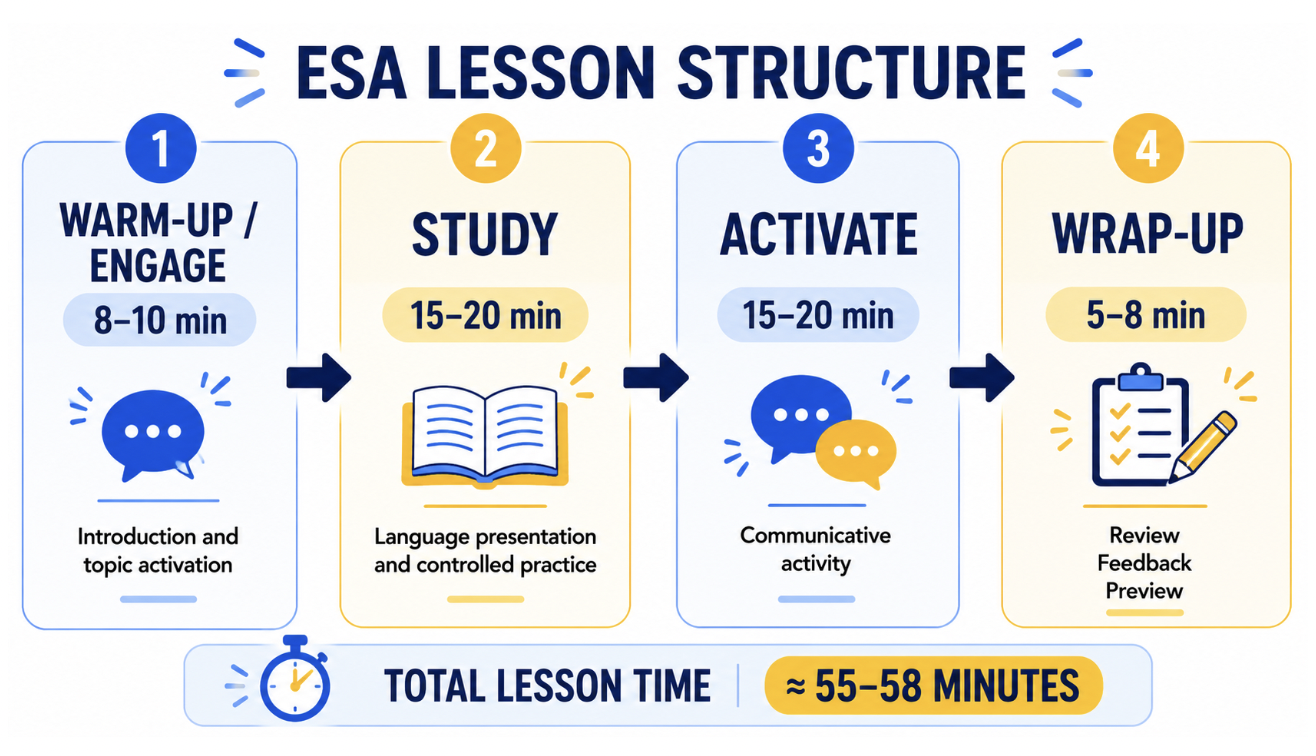
Always plan for slightly less than your total time. Leaving 2–3 minutes of buffer prevents the panic of running over.
Managing transitions
Transitions — the moments between activities — are where lessons lose momentum. Use clear, confident language to move between stages. - "Okay, let's move on to the next activity." - "Great work everyone. Now we are going to practice this in pairs." - "You have 5 minutes left. Start wrapping up your conversation." - "Before we finish, let's review what we learned today."
✓What to do if you finish early
- Have a backup activity ready — a discussion question or vocabulary game
- Do a review — "What did we learn today? Can you give me an example?"
- Give students extra practice time on the main activity
✓What to do if you run out of time
- Cut the least important activity — not the Activate stage
- Assign unfinished work as a short follow-up task
- Never rush the wrap-up — students need closure
Try This: After your next lesson, compare your planned timing to what actually happened. Which activities took longer than expected? Which were shorter? Use this information to plan more accurately next time.