Module 6: Lesson Planning for TESOL Teachers
Lesson Structure — The ESA Framework
Engage — Get students interested
Purpose: Capture attention and connect students to the topic.
Before any new language is introduced, students need a reason to care. The engage stage does exactly that.
Examples: - Show a picture and ask questions - Play a short video clip - Ask a personal question — "Have you ever had a job interview?" - Play a quick vocabulary game related to the topic
Time: 5–10 minutes
Study — Introduce new language
Purpose: Present and practice new grammar or vocabulary clearly.
This is where the main language teaching happens. Keep explanations short and always check understanding with CCQs.
Examples: - Present new grammar with examples and a timeline - Introduce vocabulary with pictures and concept checks - Analyze a model text — "What language does the writer use here?"
Time: 15–20 minutes
Activate — Use the language
Purpose: Students use the language freely in a communicative activity.
This is the most important stage — and the one most often rushed. Students need time to actually use the language they have learned.
Examples: - Role play - Discussion - Problem-solving task - Creative writing
Time: 15–20 minutes
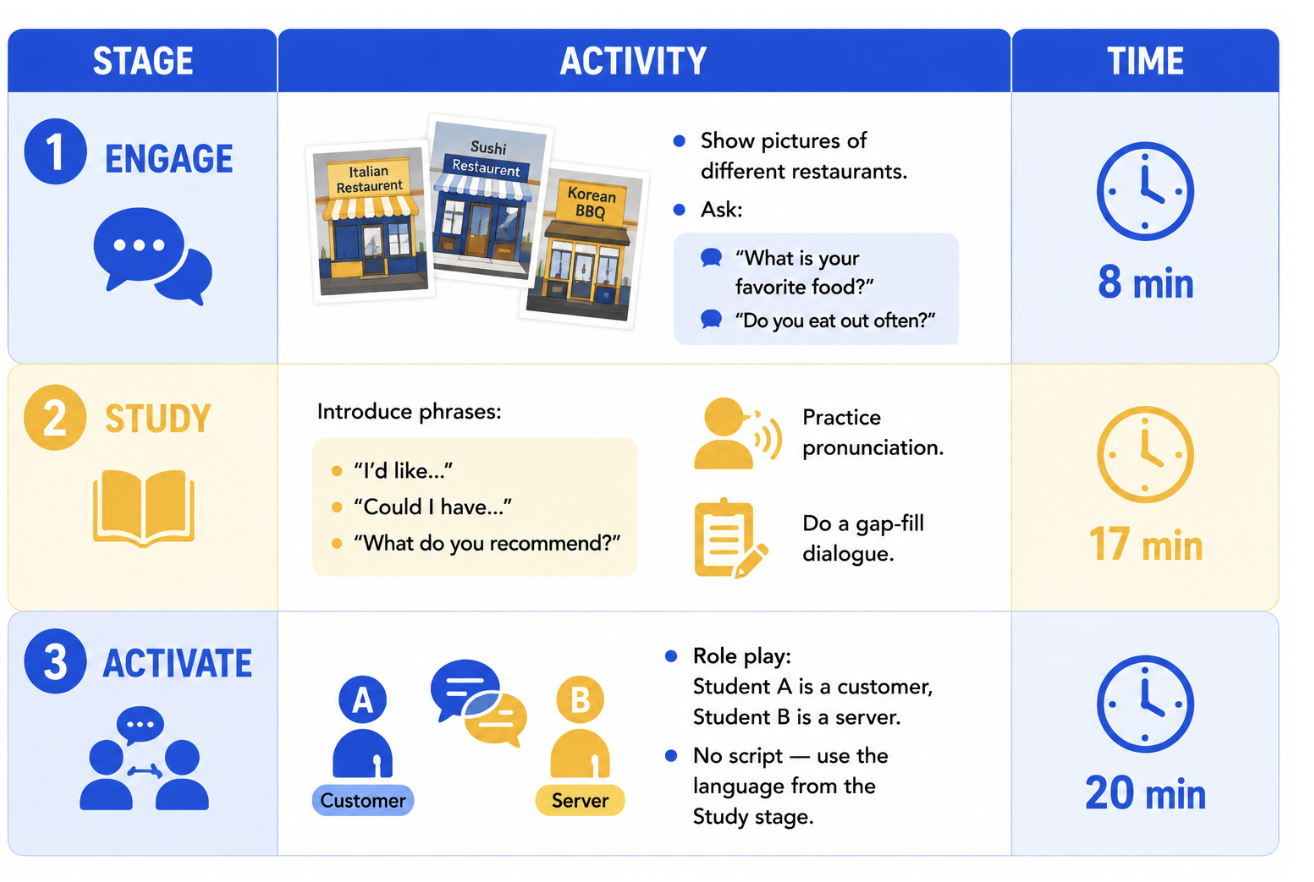
A complete ESA lesson example
Topic: Ordering food at a restaurant Level: A2 Objective: Students will be able to order food and drinks using polite request language
Try This: Always plan your Activate stage first. Once you know how students will use the language, it is much easier to decide what to teach in the Study stage and how to introduce it in the Engage stage.