Staging a Lesson — Warm-Up to Wrap-Up
A well-staged lesson feels natural and purposeful — students always know where they are and where they are going.
Why lesson staging matters
A lesson without clear stages is like a journey without a map. Teachers jump between activities, students lose the thread, and time runs out before anything is finished.
Good staging gives every minute of your lesson a purpose — and helps students move smoothly from not knowing something to being able to use it.
The 5 core lesson stages
1. Warm-Up
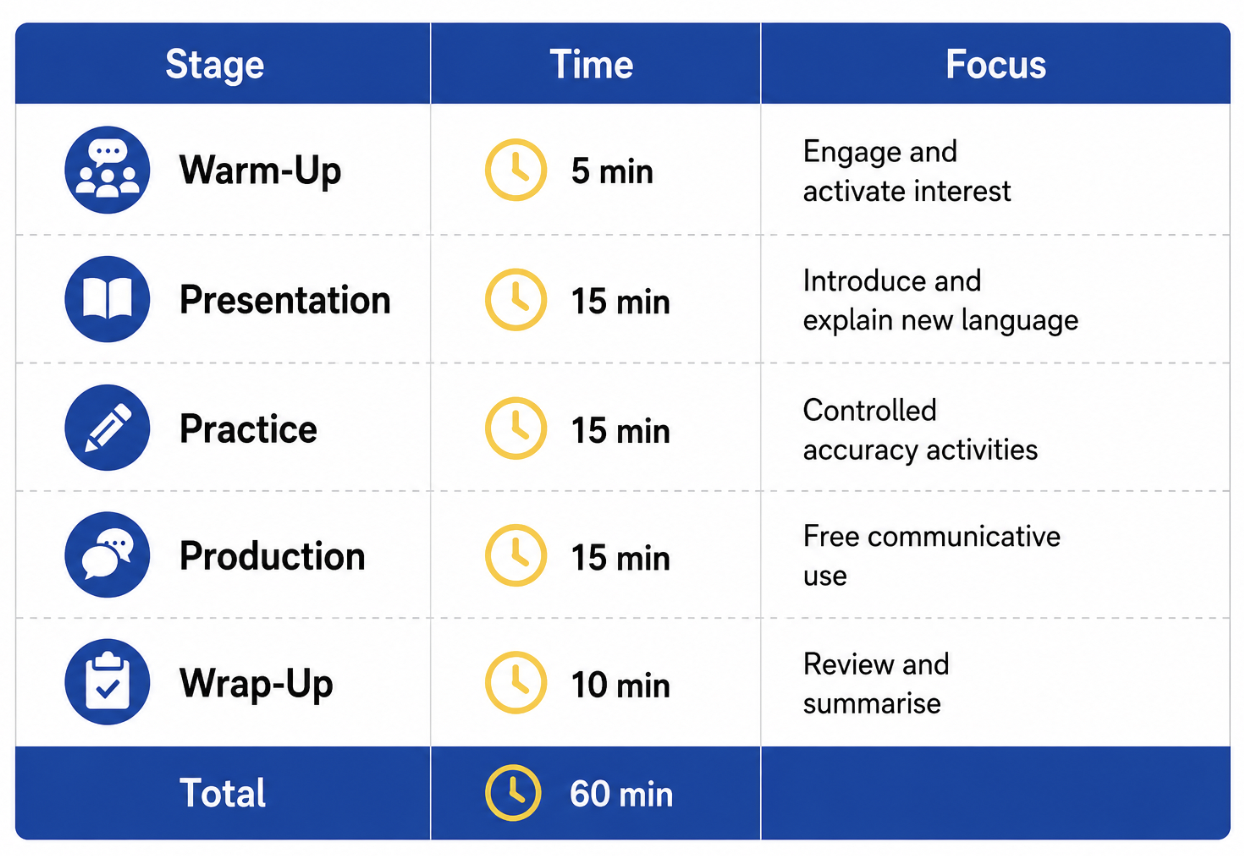
Introduce the topic and activate interest. (5 min)
The warm-up is your Engage stage. It gets students talking, thinking, and ready to learn — before any new language is introduced. - Ask a personal question connected to the topic - Show an image or short video clip - Play a quick game or brain teaser - Review vocabulary from the previous lesson
Teacher tip: A good warm-up connects directly to what comes next. Students should finish it feeling curious about the lesson topic.
2. Presentation
Introduce new language or concepts clearly. (15 min)
This is your Study stage. The teacher presents new language — grammar, vocabulary, or a text — and checks that students understand it before moving on. - Present the target language with clear examples - Check meaning — "What does this mean? When do we use it?" - Check form — "How do we make this structure?" - Check pronunciation — say it together
Teacher tip: Don't rush the presentation stage. If students don't understand the language clearly here, the practice and production stages will fall apart.
3. Practice
Students practice with accuracy-focused activities. (15 min)
Controlled practice helps students consolidate what they have just learned. The focus is on getting it right — not communicating freely yet. - Gap-fill exercises - Sentence transformation - Matching activities - Substitution drills
Teacher tip: Monitor closely during practice. Common errors here tell you what needs to be re-taught before moving to production.
4. Production
Students use language freely and communicatively. (15 min)
This is your Activate stage. Students use the target language in a more open, communicative task — with the focus on fluency, not accuracy. - Role play or simulation - Discussion or debate - Problem-solving task - Creative writing or storytelling
Teacher tip: Step back during production. Let students communicate. Take notes on errors for delayed feedback at the end.
5. Review / Wrap-Up
Check understanding and summarize learning. (10 min)
The wrap-up closes the lesson clearly. Students reflect on what they have learned — and the teacher addresses any remaining errors or confusion. - Quick vocabulary review or quiz - Ask students: "What did you learn today?" - Give delayed feedback from the production stage - Preview the next lesson
Teacher tip: Never skip the wrap-up. Students need to leave the lesson knowing what they learned — not just what they did.
Sample lesson flow — at a glance
Making smooth transitions
Good transitions help lessons feel connected — not like a series of unrelated activities. Use clear language to signal each new stage.
✓Key takeaway — you should be able to:
- Organize lesson stages in a logical sequence
- Understand the purpose of each stage and how long it should take
- Use clear transition language to move smoothly between activities