The ESA Framework — Engage, Study, Activate
A good lesson needs more than good activities — it needs a clear structure. ESA gives you a simple, research-backed framework that works for any language point at any level.
Why do we need a lesson framework?
Many new teachers plan lessons like this: "I'll explain the grammar, do some exercises, then maybe a game at the end."
The problem is that students end up knowing the rule — but can't actually use the language in real life.
ESA solves this by making sure every lesson moves through three essential stages: from interest → understanding → real use.
What is ESA?
ESA was developed by Jeremy Harmer and stands for:
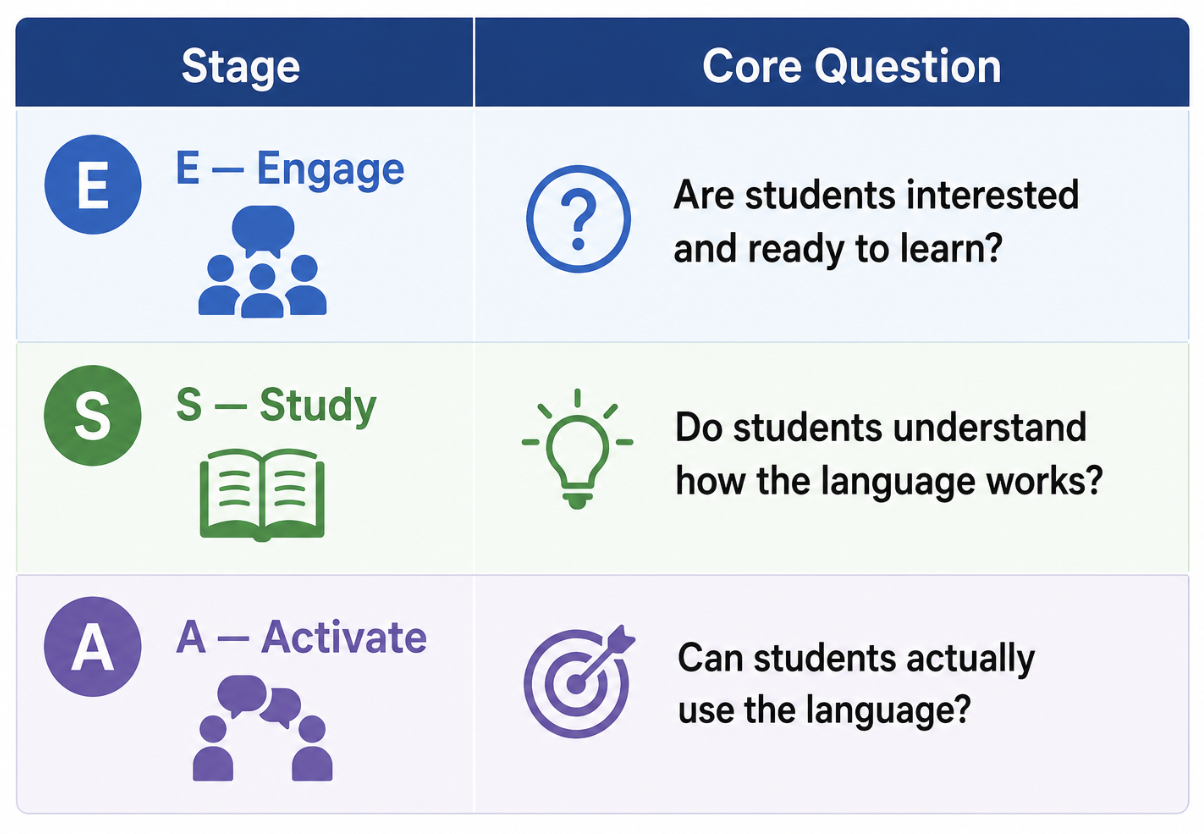
Each stage has a different purpose — and skipping any one of them weakens the lesson.
Stage 1 — Engage
Capture students' attention and create motivation to learn.
Before students can learn anything, they need to be interested. The Engage stage warms students up, activates background knowledge, and creates a reason to care about the language coming next.
What it looks like: - A short game or fun activity - Looking at a picture and discussing what they see - Watching a short video clip - A personal question or discussion - A surprising fact or problem to solve
What the teacher is doing: Creating energy, curiosity, and a connection between the topic and students' lives.
Key principle: If students are not engaged, they will not learn. Time spent on engagement is never wasted.
Stage 2 — Study
Help students understand how the language works.
Once students are engaged, they focus on the language itself — its form, meaning, and use. This is the accuracy stage. Students examine language closely, ask questions, and practice in a controlled way.
What it looks like: - A grammar explanation with examples - Vocabulary analysis — meaning, form, pronunciation - Pronunciation practice — sounds, stress, intonation - Controlled exercises — gap fills, matching, sentence building - Analyzing a model text or dialogue
What the teacher is doing: Presenting language clearly and checking that students understand it correctly before they use it freely.
Key principle: Study is about understanding — not memorising rules. Students should leave this stage knowing what the language means, how it is formed, and when to use it.
Stage 3 — Activate
Give students the opportunity to use the language freely and communicatively.
This is the most important stage — and the one most often rushed or skipped. Activate moves students from knowing the language to using it. The focus shifts from accuracy to fluency.
What it looks like: - A role play or simulation - A debate or discussion - A storytelling task - A problem-solving activity - A creative writing or speaking task
What the teacher is doing: Stepping back and letting students communicate. The teacher monitors, takes notes, and gives delayed feedback at the end.
Key principle: Activate activities should feel real — students speak or write because they have something to say, not just to practice a structure.
How ESA connects — the full picture
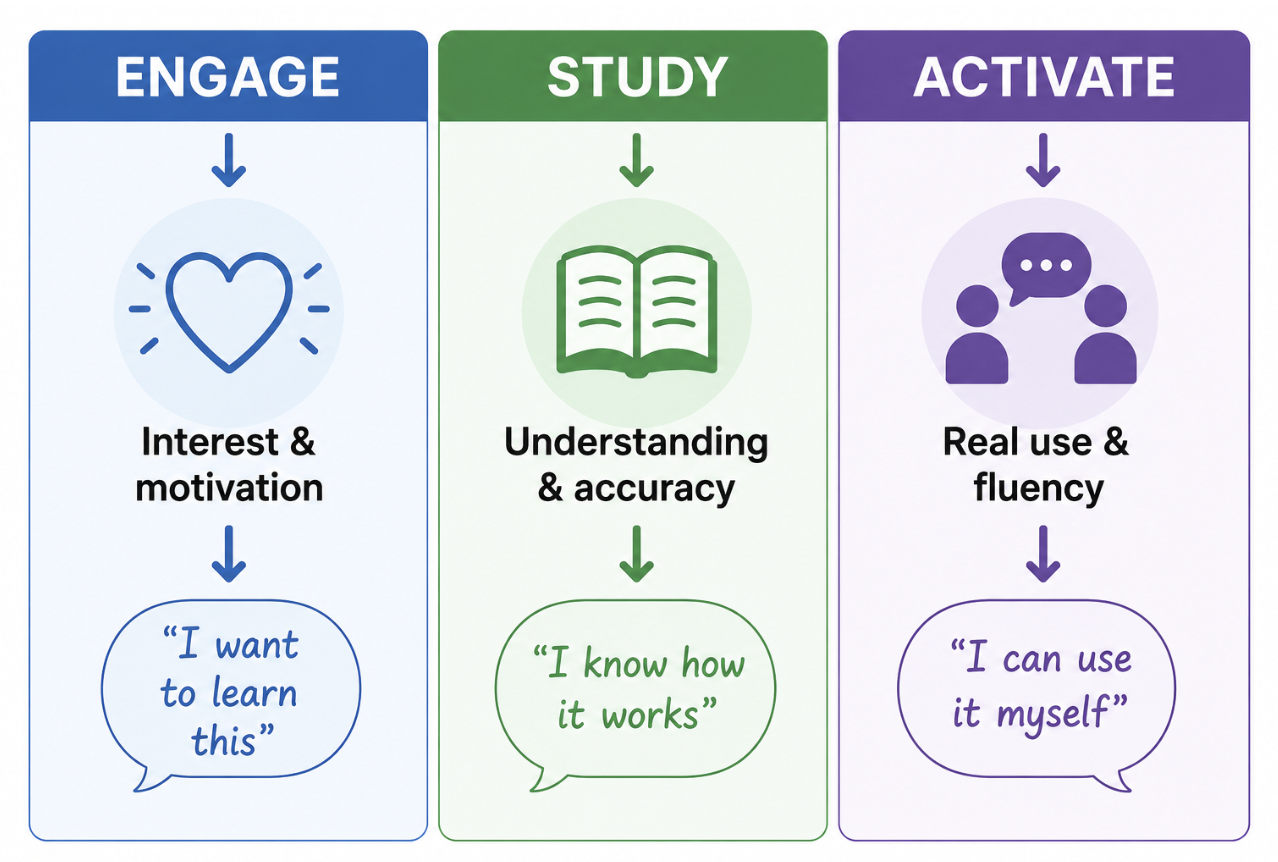
Each stage builds on the previous one. Without Engage, students are unmotivated. Without Study, students guess and make errors. Without Activate, students know the rule but can't use the language in real life.
ESA in practice — a complete lesson example
Topic: Ordering Food in a Restaurant Level: A2–B1 Target language: "I'd like...", "Could I have...", "What do you recommend?"
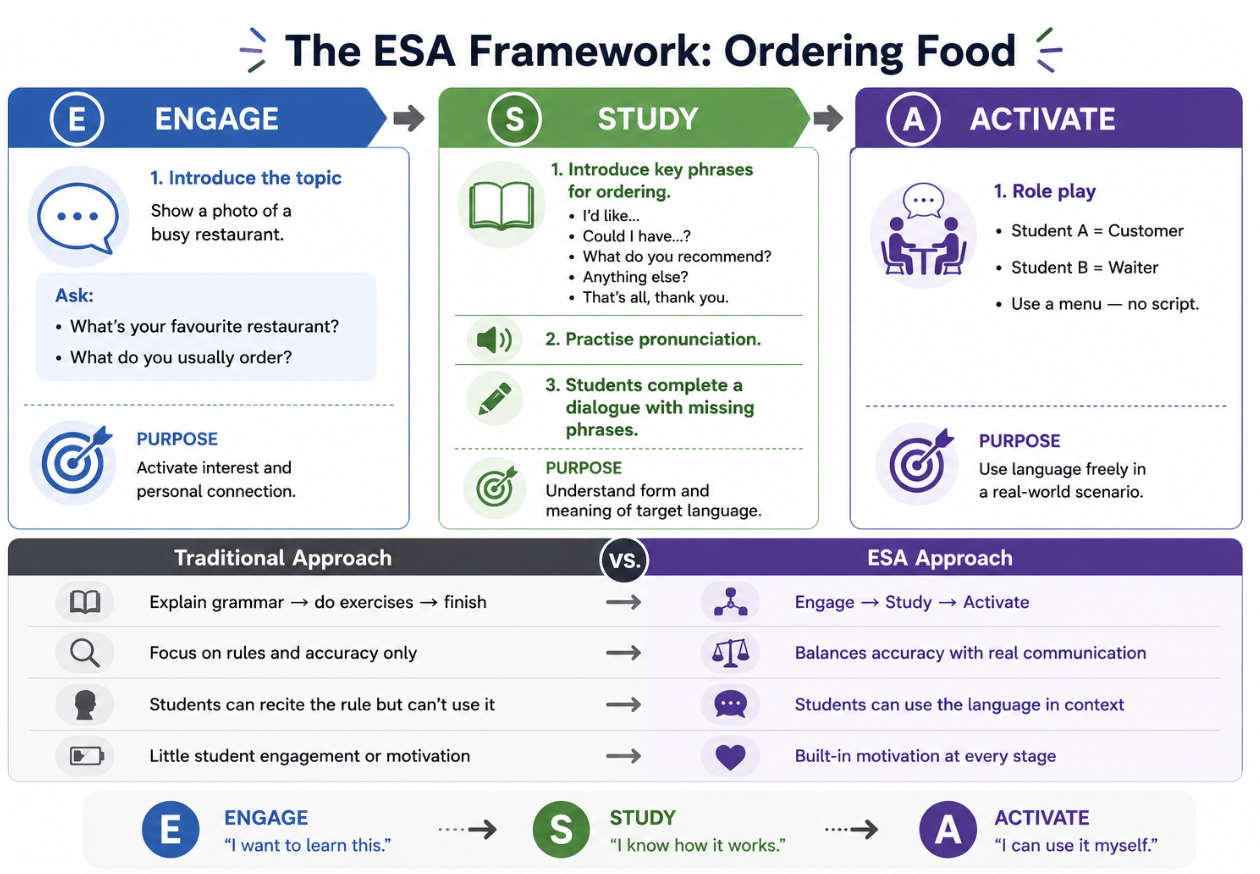
ESA vs the traditional approach
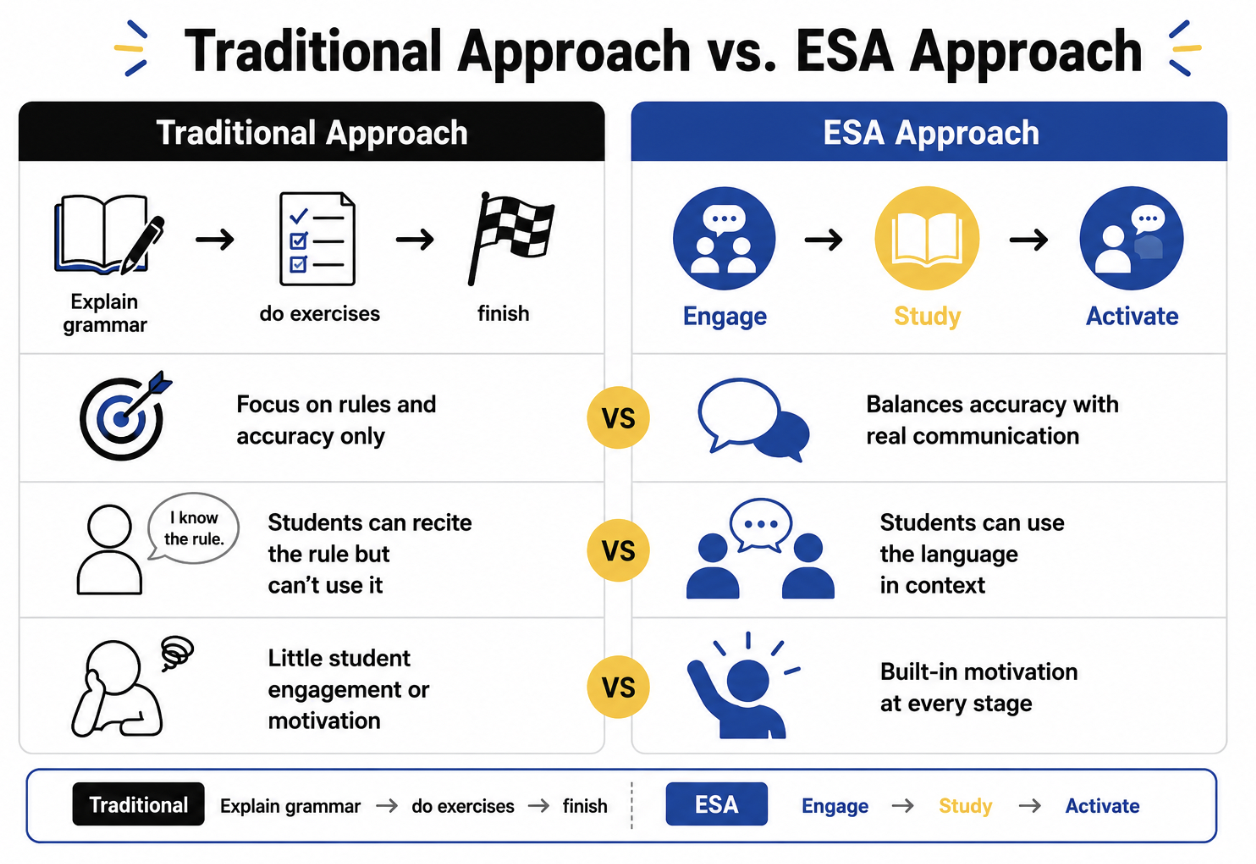
ESA works because it mirrors how language is actually learned — through interest, understanding, and use. It is not a rigid formula — it is a flexible framework you can adapt to any topic, level, or activity. Master ESA and you have a structure that works for every lesson you will ever teach.