Student-Centered Learning
All of the methodologies in this module share one thing in common — they put the student at the center of the learning experience. This is one of the most important ideas in modern teaching.
What is student-centered learning?
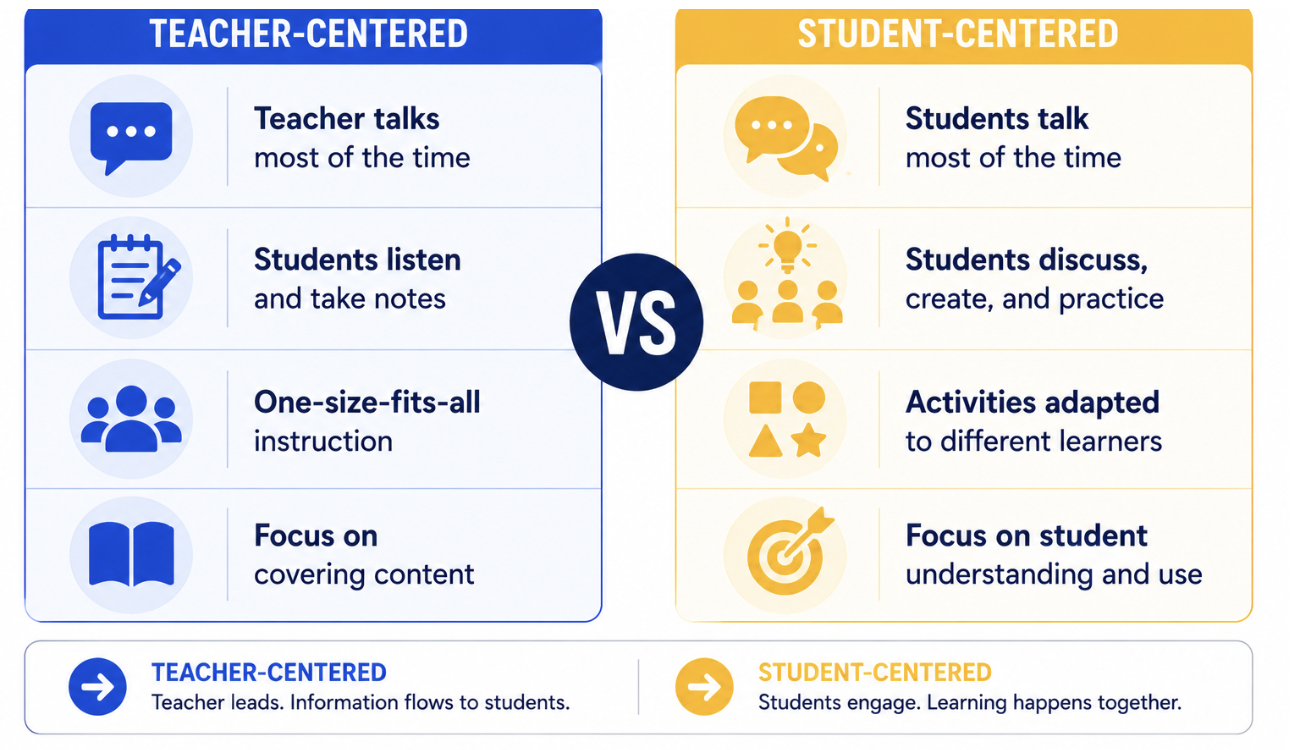
In a traditional classroom, the teacher talks and students listen. In a student-centered classroom, students are actively involved — speaking, discussing, creating, and problem-solving — while the teacher guides and supports.
Teacher-centered vs student-centered
✓What student-centered teaching looks like
- More pair work and group work — less whole-class instruction
- Students make choices — about topics, partners, or task formats
- The teacher monitors and supports — instead of standing at the front talking
- Activities reflect students' real lives and interests
- Students are encouraged to ask questions and take risks
The teacher's new role
In a student-centered classroom the teacher is: - A facilitator — creating conditions for learning - A coach — guiding students toward their goals - A resource — available when students need support - An observer — watching how students use language and adjusting accordingly
Remember: Student-centered does not mean the teacher does nothing. It means the teacher works differently — designing great activities, monitoring carefully, and supporting students to do the heavy lifting themselves.