Introduction to AI Tools for Teachers
Artificial intelligence is not here to replace teachers — it is here to give great teachers more time to do what only humans can do.
Artificial intelligence has entered the classroom — and for English teachers, the timing could not be better. AI tools can handle time-consuming tasks, generate materials instantly, and provide personalized support to students at scale. But to use AI well, you first need to understand what it is, what it can do, and — just as importantly — what it cannot do.
What is AI in the context of teaching?
Artificial intelligence refers to computer systems that can perform tasks that typically require human intelligence — such as understanding language, generating text, analyzing writing, and providing feedback.
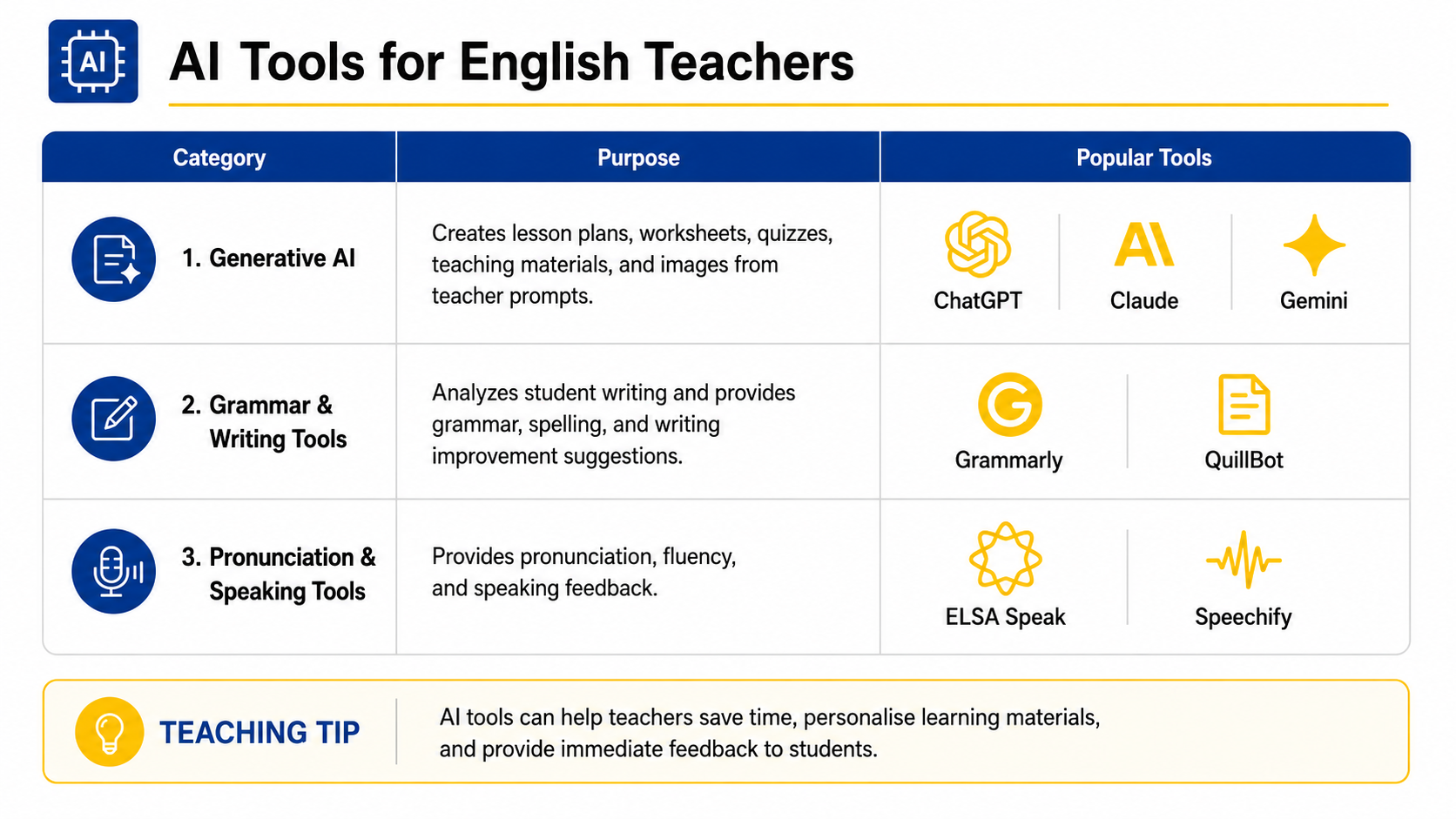
For English teachers, the most relevant AI tools fall into three categories:
✓What AI can do for English teachers
- Generate lesson plans and activity ideas in seconds
- Create reading texts, gap-fill exercises, and vocabulary lists on any topic
- Provide instant written feedback on student drafts
- Suggest differentiated tasks for different learner levels
- Translate instructions and explanations for multilingual classrooms
- Create quiz questions and assessment materials quickly
- Summarize research articles and professional development resources
What AI cannot do
Understanding the limitations of AI is just as important as knowing its capabilities. - AI cannot replace human connection — rapport, empathy, and the ability to read a room are uniquely human - AI cannot guarantee accuracy — AI tools sometimes produce incorrect information, known as "hallucinations." Always verify AI-generated content before using it with students. - AI cannot assess spoken communication in real time — live speaking tasks still require a human teacher - AI cannot make pedagogical judgments — AI doesn't know your students, your context, or your teaching goals. You do. - AI cannot replace professional expertise — AI is a tool. The teacher's knowledge, judgment, and creativity remain essential.
AI and academic integrity
One of the most significant challenges AI presents for teachers is the risk of students using it to complete their work for them.
Strategies for maintaining academic integrity: - Design tasks that require personal reflection — "Write about your own experience of..." - Use in-class writing tasks where AI access is limited - Focus on the writing process — drafts, revisions, and reflections — not just the final product - Discuss AI use openly with students — set clear expectations about when it is and is not appropriate - Use AI detection tools with caution — they are not always accurate
Key principle: Rather than banning AI entirely, teach students how to use it responsibly and ethically. This is a skill they will need throughout their lives.
✓By the end of this lesson, you should be able to:
- Explain what AI tools are and how they are relevant to English language teaching
- Identify what AI can and cannot do in a teaching context
- Describe strategies for maintaining academic integrity in an AI-enabled classroom