Module 4: Teaching Core Language Skills
Integrating the Four Skills
In real-world communication, we rarely use just one skill at a time. The best ESL lessons reflect this by integrating multiple skills in a natural, connected way.
Why skill integration works
When skills are connected in a lesson, students: - See how language works across different contexts - Practice more language in a meaningful way - Stay more engaged — the lesson flows naturally from one activity to the next - Build skills that transfer to real communication
A simple integrated lesson structure
Listen → Discuss → Read → Write
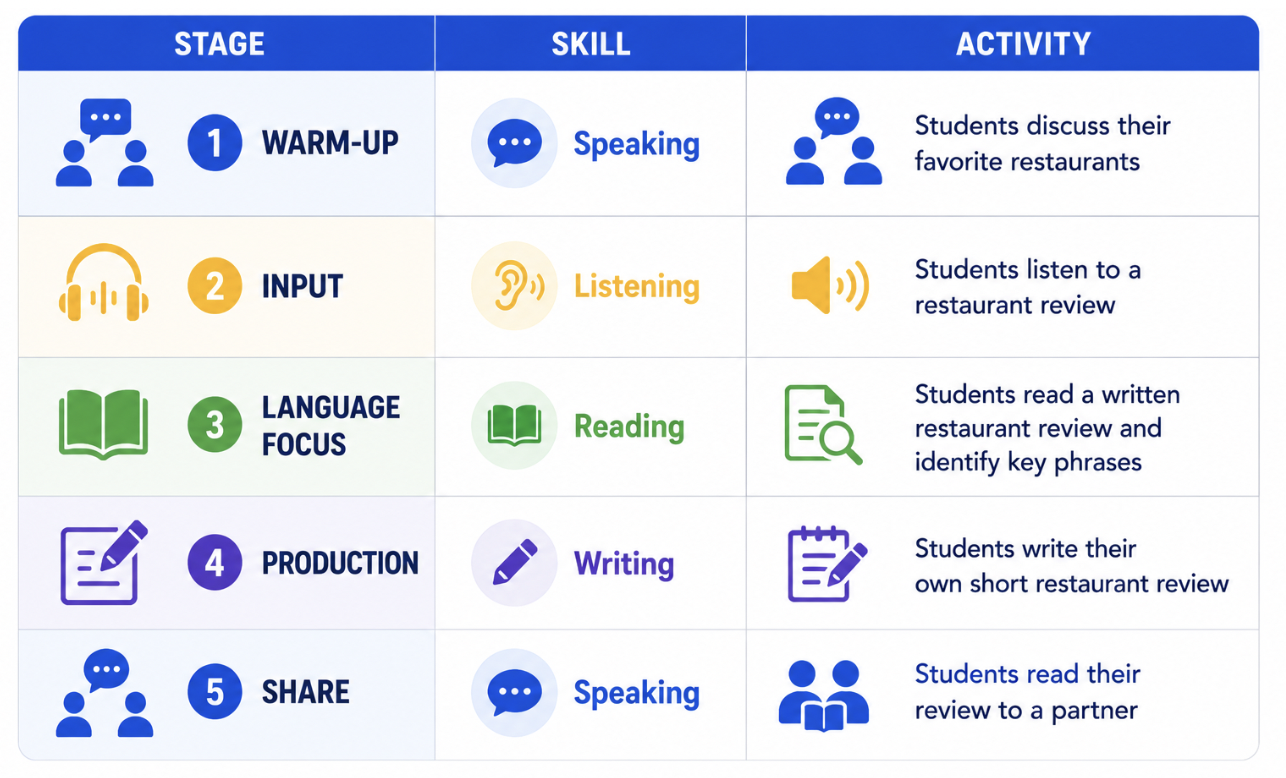
Every skill appears naturally. Students move through the lesson without feeling like they are switching gears.
✓Tips for integrating skills
- Connect skills around a single theme or topic
- Use the output of one activity as the input for the next
- Make sure productive skills — speaking and writing — always have a real purpose
- Do not force integration — if a skill does not fit naturally, leave it out
Try This: Design a 30-minute integrated lesson around a topic your students care about. Start with a speaking activity, move to a reading or listening task, and end with a short writing or speaking production. Notice how the lesson flows more naturally than a single-skill lesson.