Module 4: Teaching Core Language Skills
Teaching Reading
Reading helps students build vocabulary, understand grammar in context, and develop comprehension skills. But reading in a second language is hard — and choosing the wrong text or the wrong task can quickly discourage students.
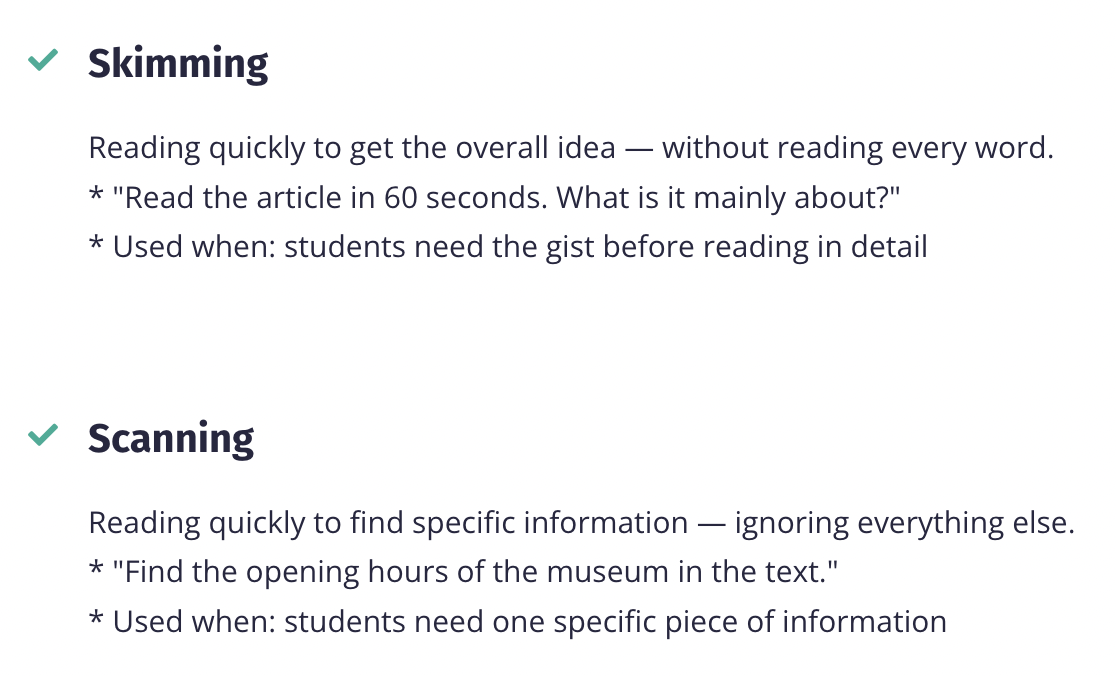
Two essential reading strategies
The three-stage reading lesson
✓Pre-reading
- Introduce the topic and activate background knowledge
- Pre-teach essential vocabulary
- Set a reading purpose — tell students what they are looking for
While-reading
First read — skim: Students read quickly for the overall idea. Second read — detail: Students read carefully to answer specific questions. - Use a variety of question types — not just factual recall - Include inference questions — "Why do you think the writer says this?" - Encourage students to guess unknown words from context
✓Post-reading
- Discuss the text — "What did you think? Do you agree with the writer?"
- Focus on useful vocabulary or language from the text
- Connect to a speaking or writing task
✓Choosing the right text
- The text should be slightly challenging — not too easy, not overwhelming
- Students should know at least 90–95% of the words
- Choose topics students find interesting or relevant to their lives
- Use a variety of text types — articles, emails, stories, instructions
Try This: Before your next reading lesson, read the text yourself and identify 3–4 words students might not know. Pre-teach those words — then let students work out the meaning of everything else from context.