Error Correction
Making mistakes is not a sign of failure. It is a sign that a student is learning.
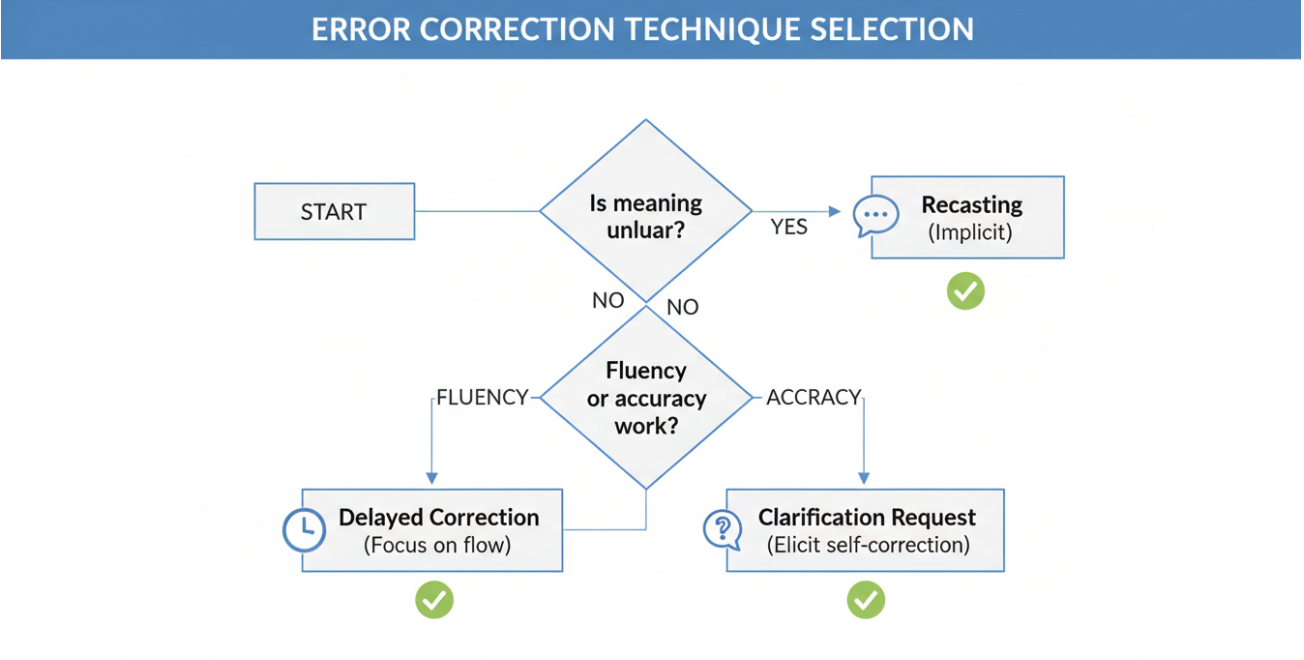
The golden rule: During fluency activities do not interrupt. During accuracy activities correct supportively.
✓Recasting
Repeat what the student said but correctly without making a big deal of it.
Best for: Fluency activities, younger learners, anxious students.
- Student: Yesterday I go to the store.
- Teacher: Oh, you went to the store! What did you buy?
✓Clarification Request
Ask the student to repeat or clarify which gives them a chance to self-correct.
Best for: When the error is minor and the student might catch it themselves.
- Student: I very like pizza.
- Teacher: Sorry, could you say that again?
- Student: I really like pizza.
✓Delayed Correction
During the activity quietly note errors. After the activity write them on the board and ask the class to correct them together.
Best for: Speaking activities, group work, fluency tasks.
When NOT to correct: - Do not correct every mistake - Do not correct during a fluency activity - Do not embarrass students - Do not correct mistakes that do not affect communication