Designing Pre-, While-, and Post-Listening Tasks
You have chosen your listening material. Now, how do you build a complete listening lesson around it? The most effective listening lessons follow a three-stage structure: Pre-listening → While-listening → Post-listening.
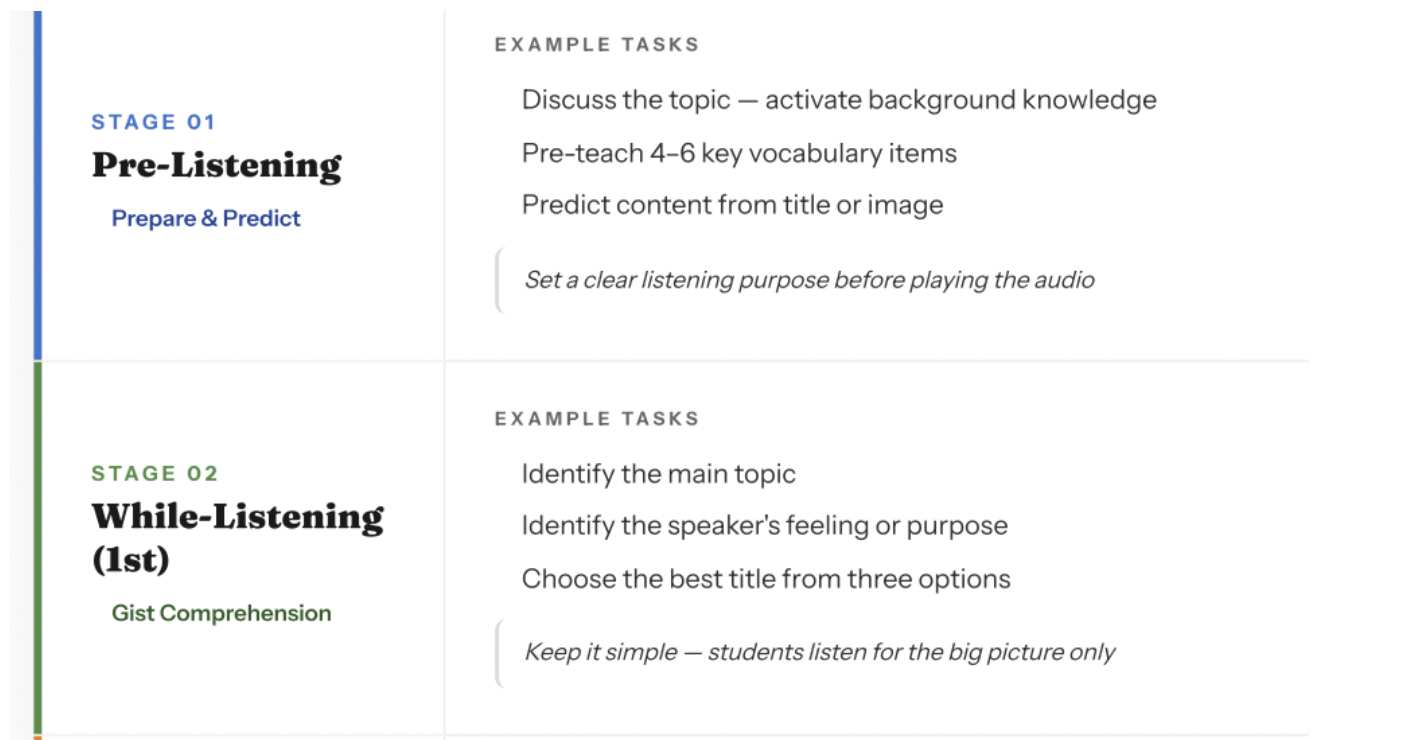
Stage 1: Pre-Listening
Purpose: Prepare students to listen successfully. - Activate background knowledge — "Have you ever experienced a flight delay? What happened?" - Predict content — Show students the title or a key image and ask them to predict what they will hear. - Pre-teach key vocabulary — Introduce 4–6 essential words. Don't pre-teach everything — leave some vocabulary for students to work out from context. - Set a listening purpose — "Listen and find out: where is the speaker going, and why?"
Why this matters: Students who know what they are about to hear are significantly more successful listeners.
Stage 2: While-Listening
Purpose: Guide students to engage with the text actively.
Round 1 — Gist (first listening) - "What is the main topic of the conversation?" - "How does the speaker feel — positive, negative, or neutral?"
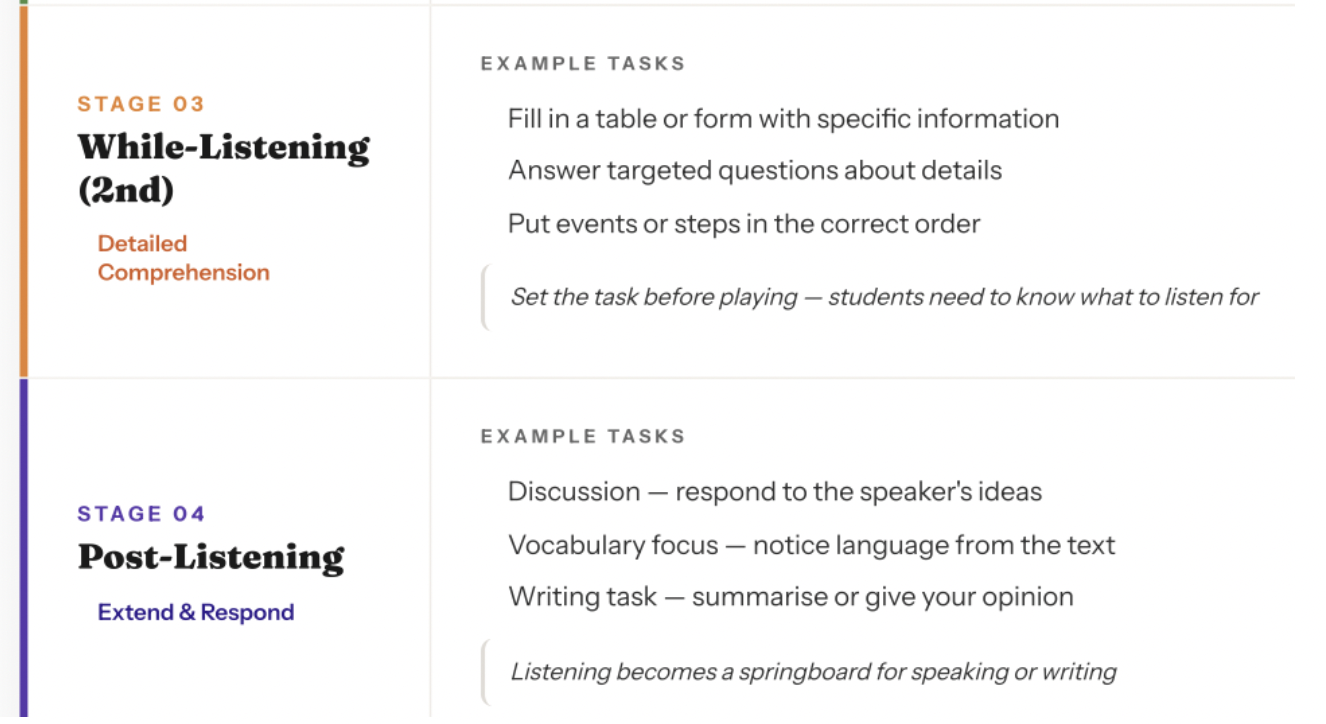
Round 2 — Detail (second listening) - "What three reasons does the speaker give?" - Fill in the missing information in a table or form - Put events in the correct order
Important rules: - Set the task before playing the audio - Play the recording at least twice - Use the pause button for longer or more complex texts - Do not ask students to write long answers while listening
Stage 3: Post-Listening
Purpose: Extend the listening into language learning and communication. - Comprehension check — Discuss answers as a class - Language focus — Draw students' attention to interesting language from the text - Speaking or writing response — Connect the listening to a productive skill - Reflection — "What helped you understand? What was difficult?"
A Complete Listening Lesson — At a Glance
Key takeaway: A good listening lesson is not just "press play and answer questions." The pre-, while-, and post-listening structure gives every stage a clear purpose — and that structure is what turns passive hearing into active learning.
✓By the end of this lesson, you should be able to:
- Design a complete listening lesson using the pre-, while-, and post-listening framework
- Write appropriate tasks for each stage of the listening lesson
- Explain the purpose of each stage in the listening lesson framework