Self-Evaluation and Reflective Practice
The practicum is not just about being evaluated by others — it is about learning to evaluate yourself. Reflective practice is the habit that separates good teachers from great ones. This lesson shows you how to build it. What is reflective practice? Reflective practice means deliberately thinking about your teaching — what happened, why it happened, and what you would do differently next time. It is not the same as thinking "that lesson went well" or "that was a disaster." Reflective practice is structured, honest, and forward-looking. "We do not learn from experience. We learn from reflecting on experience." — John Dewey
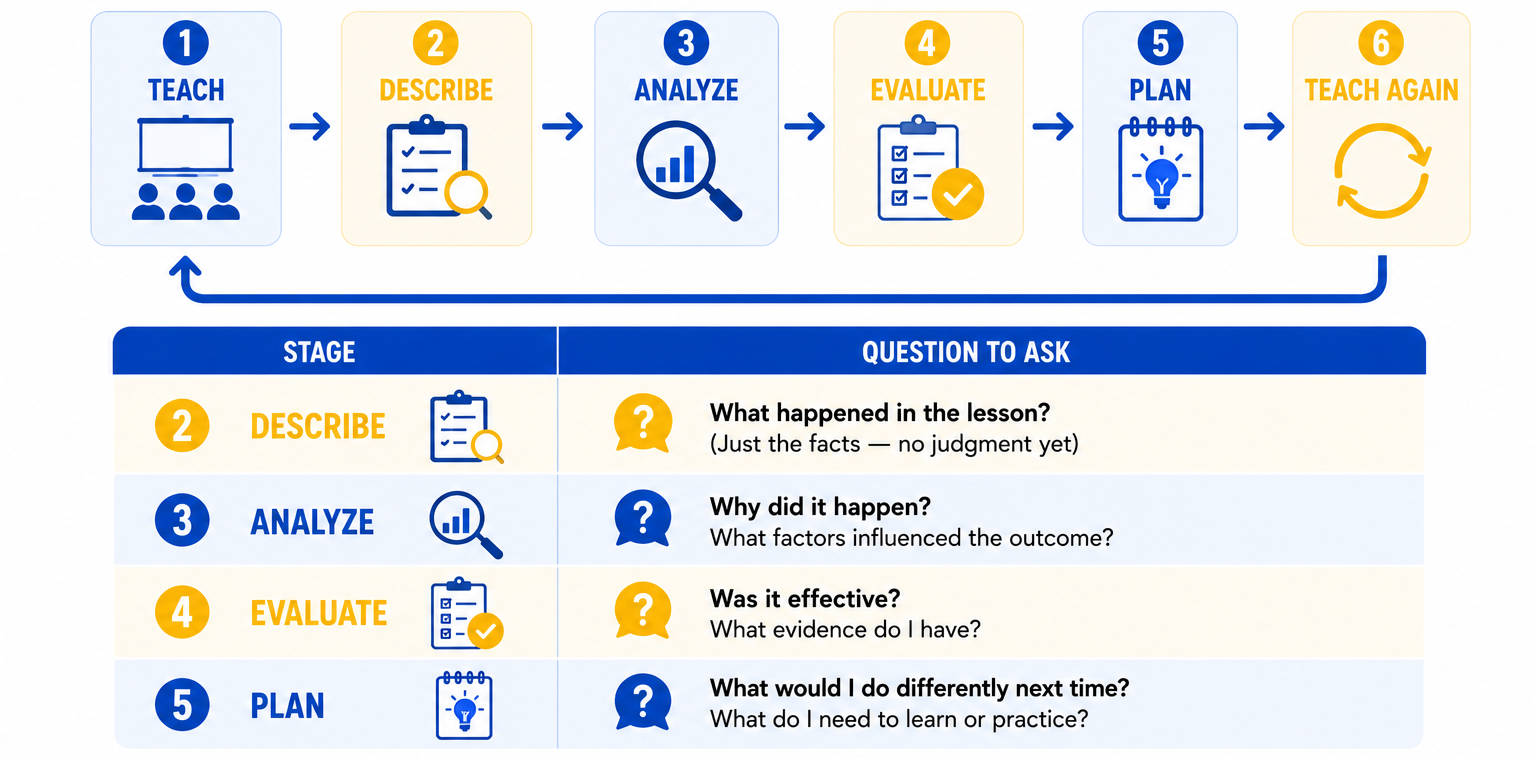
Tools for reflective practice
✓Post-lesson reflection journal
After every lesson, write brief notes. Don't wait — memory fades quickly.
Reflection prompts:
- What was the objective — and did students achieve it? How do I know?
- Which activity worked best? Why?
- Which activity didn't work? What would I change?
- Was there a moment I felt confident? What caused that?
- Was there a moment I felt lost? What caused that?
- What is one thing I want to do better in my next lesson?
Even five minutes of written reflection after a lesson compounds into significant professional growth over time.
✓Self-observation — recording your teaching
Recording yourself teaching — audio or video — and watching it back is one of the most powerful development tools available to teachers.
Most teachers find this uncomfortable at first. That discomfort usually means you are noticing things you would not otherwise see.
What to look for when watching yourself: - How much time do you spend talking vs students? - Are your instructions clear the first time? - Do you make eye contact with all areas of the room? - How do you respond when a student gives a wrong answer? - Do you check understanding — or assume it? - What is your body language communicating?
✓The post-observation self-evaluation form
After an observed lesson, complete a structured self-evaluation before receiving assessor feedback. This trains you to evaluate your own teaching honestly — and prepares you for a more productive feedback conversation.
Post-Observation Self-Evaluation:
[IMG:tesol160_19-6.png]
Receiving feedback — how to get the most from it
Feedback from an assessor or mentor is a gift — even when it is uncomfortable. Here is how to make the most of it: - Listen without defending — resist the urge to explain or justify immediately - Ask clarifying questions — "Can you give me an example of what you mean?" - Take notes — you will not remember everything - Identify one or two actionable takeaways — don't try to change everything at once - Follow up — after your next lesson, reflect on whether you applied the feedback The teachers who grow fastest are not the ones who receive the best feedback — they are the ones who act on it most consistently. Key takeaway : - Explain what reflective practice is and why it matters for professional growth - Use the reflective practice cycle to analyze your own teaching - Complete a structured post-observation self-evaluation