Observed Teaching — What Assessors Look For
Being observed can feel intimidating — but it doesn't have to be. This lesson breaks down exactly what assessors look for, how observed lessons are typically structured, and how to perform at your best when it counts. The observation cycle Most observed teaching experiences follow a three-part cycle:
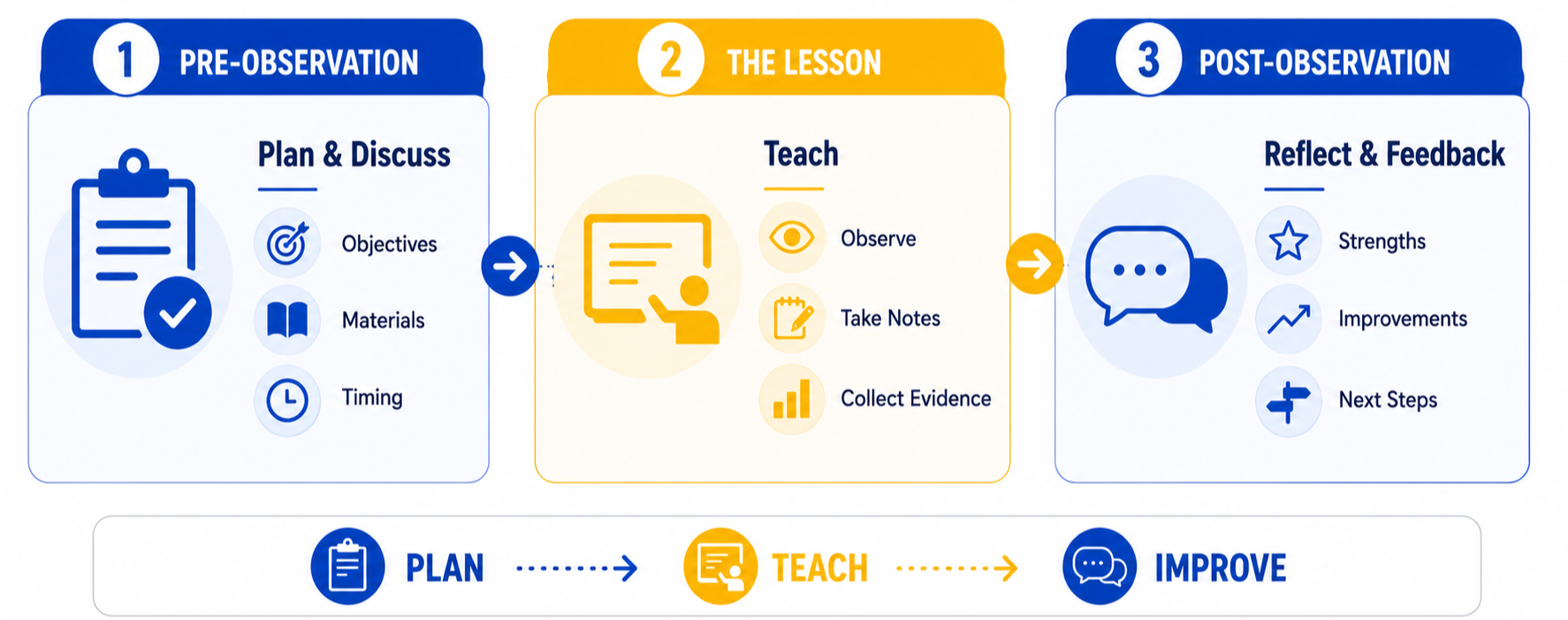
✓Pre-observation meeting
Before the lesson, you may meet with your assessor or mentor to:
- Share your lesson plan and discuss your objectives
- Identify any focus areas for the observation
- Ask questions or raise concerns
Use the pre-observation meeting to your advantage. Share your thinking — why you designed the lesson the way you did. Assessors value reflective, intentional teachers.
✓The observed lesson
This is where you teach. The assessor will observe, take notes, and — in some programs — complete a structured observation form.
✓What assessors are NOT looking for:
- A perfect lesson with no problems
- A performance designed to impress
- Complicated, flashy activities
✓What assessors ARE looking for:
- A clear, purposeful lesson that serves the learners
- Natural, confident classroom presence
- Responsive teaching — adapting to what is actually happening in the room
- Evidence that you understand the principles behind your decisions
✓Post-observation feedback
After the lesson, you will typically receive structured feedback from your assessor. This may include:
The observation rubric — what gets evaluated
Most observation forms evaluate teachers across several dimensions. Here is a typical framework:
- Strengths — what worked well and why
- Areas for development — specific, actionable suggestions
- Questions — designed to prompt your own reflection
![tesol160_19-4.png]
**Reducing observation anxiety**
Observation anxiety is completely normal — even experienced teachers feel it.
Here are practical strategies to manage it:
- **Reframe the observation **— think of it as professional support, not judgment
- **Focus on your students **— when you focus on the people in front of you, you forget to be nervous
- **Accept imperfection** — assessors know you are a new teacher. They are not looking for perfection.
- ** Breathe** — slow, deliberate breathing before and during the lesson reduces physical anxiety symptoms
- **Have a plan B** — knowing you can adapt if something goes wrong removes the fear of the unexpecte](/tesol160_19-4.png]
**Reducing observation anxiety**
Observation anxiety is completely normal — even experienced teachers feel it.
Here are practical strategies to manage it:
- **Reframe the observation **— think of it as professional support, not judgment
- **Focus on your students **— when you focus on the people in front of you, you forget to be nervous
- **Accept imperfection** — assessors know you are a new teacher. They are not looking for perfection.
- ** Breathe** — slow, deliberate breathing before and during the lesson reduces physical anxiety symptoms
- **Have a plan B** — knowing you can adapt if something goes wrong removes the fear of the unexpecte)
✓If something goes wrong
Things will go wrong. An activity will take longer than planned. A student will ask a question you can't answer. The technology will fail. This is normal — and how you handle it tells assessors more about your teaching ability than a perfect lesson would.
✓When things go wrong:
Assessors are not looking for a perfect teacher. They are looking for a thoughtful, responsive teacher who knows why they are doing what they are doing — and who can learn from experience.
- Stay calm — panic is visible and affects the whole class
- Adapt — use your judgment to adjust in the moment
- Keep students focused — give them a task while you sort out the problem
- Reflect afterward — what did you learn? How would you handle it differently next time?
✓Key takeaway :
- Describe the three stages of the observation cycle
- Explain what assessors look for in an observed lesson
- Apply practical strategies to manage observation anxiety