Standardized Testing — IELTS, TOEFL, and Beyond
Many of your students will need to take standardized proficiency tests for university admission, immigration, or professional certification. This lesson goes beyond the basics of exam preparation (covered in Module 13) and focuses on the advanced knowledge teachers need to support students effectively.
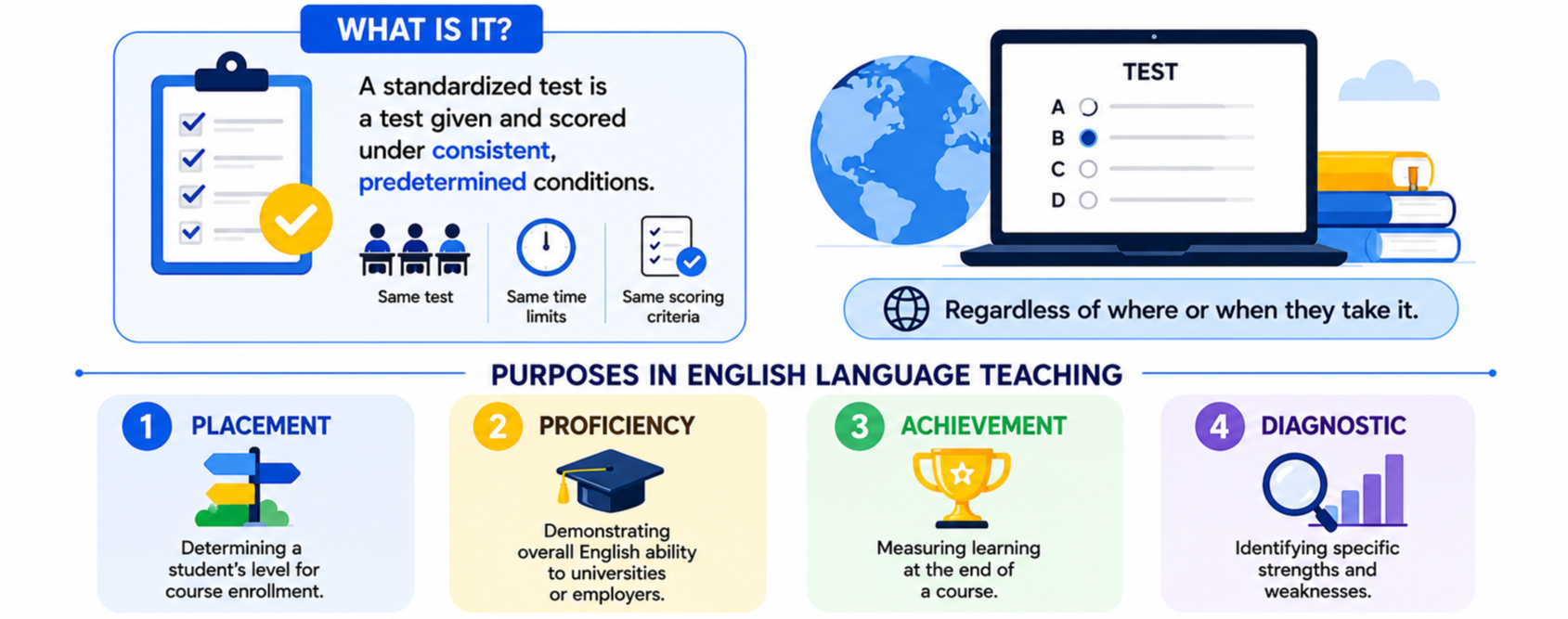
Standardized tests in English language teaching serve several purposes: - Placement — determining a student's level for course enrollment - Proficiency — demonstrating overall English ability to universities or employers - Achievement — measuring learning at the end of a course - Diagnostic — identifying specific strengths and weaknesses Major standardized tests [IMG:tesol160_18-6.png] Understanding test scoring As a teacher preparing students for standardized tests, you need to understand how these tests are scored — not just what they contain. IELTS band descriptors IELTS uses a 9-band scale. Each band corresponds to a level of English ability: [IMG:tesol160_18-7.png] Most US universities require a minimum of Band 6.5 or 7.0 for undergraduate admission. TOEFL scoring Each of the four sections (Reading, Listening, Speaking, Writing) is scored 0–30. Total scores range from 0–120. Most selective US universities require 90–100+. Advanced exam preparation strategies Going beyond the basics of exam preparation (Module 13), advanced preparation involves:
✓Diagnostic assessment first
Before starting exam preparation, identify each student's specific weaknesses through a diagnostic test.
- Which section is weakest?
- Which question types cause the most difficulty?
- Is the issue language ability or test strategy?
✓Targeted skill development
Based on diagnostic results, target the specific skills and language areas that will have the greatest impact on the student's score.
- A student scoring Band 5.5 in IELTS Writing Task 2 may need to focus on argument structure and cohesion — not just grammar
- A student struggling with TOEFL Listening may need exposure to a wider range of accents and note-taking strategies
✓Timed practice under realistic conditions
Regular timed practice is essential — but it must be followed by detailed feedback.
- Practice a full section under timed conditions
- Analyze the results together — what went wrong and why?
- Target the specific errors in the next lesson
✓Test anxiety management
High-stakes tests create significant anxiety for many learners. Advanced preparation includes:
- Gradual exposure to timed conditions — start with shorter tasks and build up
- Familiarity with test format — anxiety is often caused by the unknown
- Strategy training — having a clear approach to each question type reduces panic
- Positive self-talk and mindset coaching
Exam preparation is most effective when it develops real language ability alongside test strategy. Students who improve their actual English will always outperform those who only practice test tricks. Key takeaway : - Compare the major standardized English proficiency tests and their purposes - Understand how IELTS and TOEFL are scored and what scores mean - Apply advanced exam preparation strategies including diagnostic assessment and targeted skill development