Formative vs. Summative Assessment
There are two main types of assessment in language teaching — and understanding the difference between them changes how you plan, teach, and respond to student performance.
Summative Assessment
Assessment of learning — measuring what students have achieved.
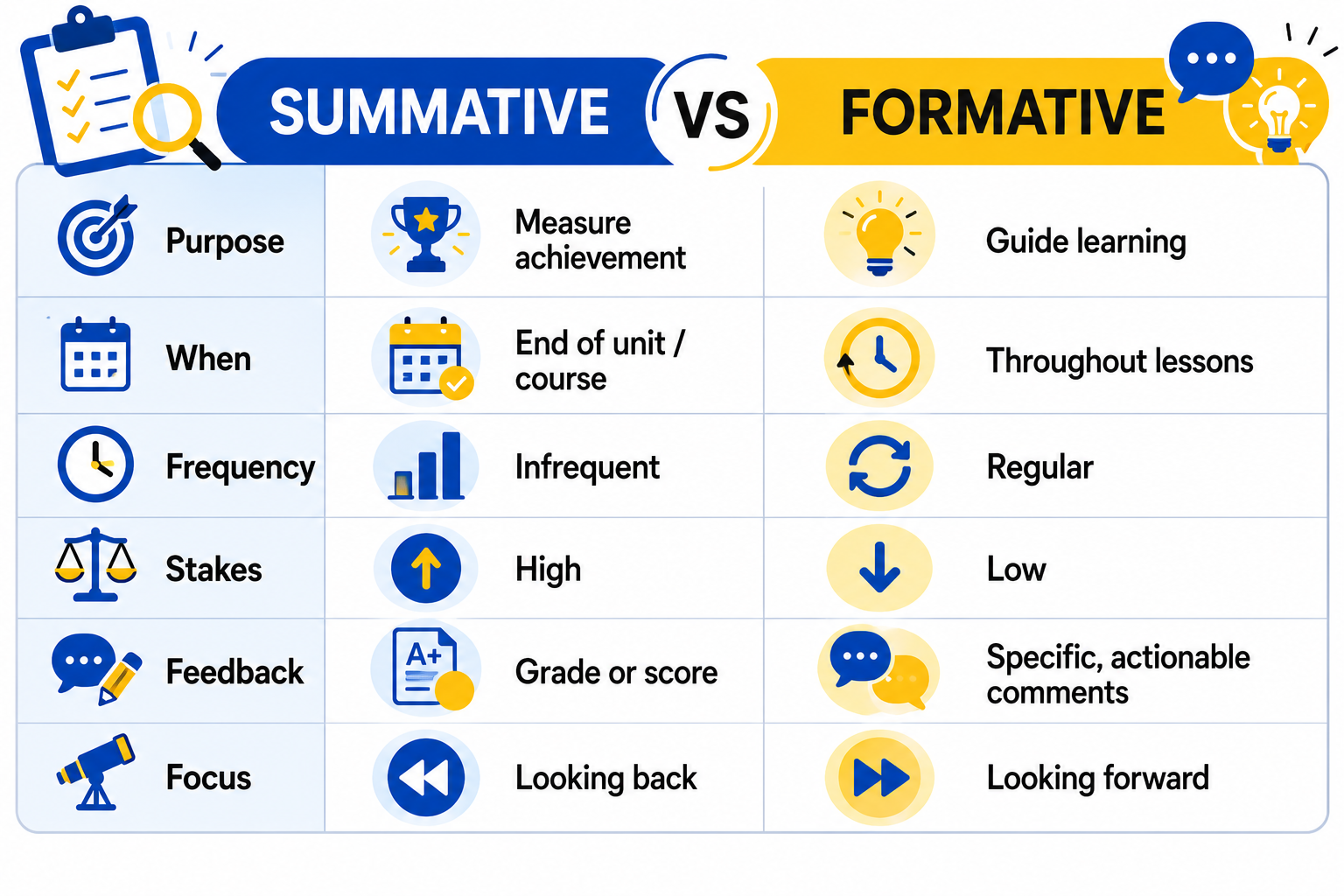
Summative assessment happens at the end of a unit, course, or period of study. It measures what students have learned overall.
Examples: - End-of-term tests - Final exams - Course portfolios submitted at the end of a program - Formal speaking assessments
Characteristics: - Has a grade or score attached - Looks backward — what has the student learned so far? - Results are reported to students, parents, or institutions - Less frequent — typically once per unit or term
Formative Assessment
Assessment for learning — guiding the learning process.
Formative assessment happens throughout the learning process. It gives both teacher and student ongoing information about progress — so teaching and learning can be adjusted in real time.
Examples: - Classroom observation during activities - Quick comprehension checks — "Can everyone give me a thumbs up if that makes sense?" - Exit tickets — students write one thing they learned and one question they still have - Peer feedback during a writing or speaking task - Informal quizzes at the start of a lesson
Characteristics: - May or may not have a grade attached - Looks forward — what does the student need to work on next? - Low stakes — designed to support learning, not judge it - Frequent — happens in almost every lesson
Summative vs Formative — at a glance
Why formative assessment is often more valuable
Many teachers focus most of their energy on summative assessment — preparing students for tests. But research consistently shows that frequent, low-stakes formative assessment has a greater impact on learning than high-stakes testing.
Formative assessment: - Catches misunderstandings before they become habits - Keeps students actively engaged in monitoring their own progress - Allows teachers to adjust teaching in real time - Reduces test anxiety by making assessment a normal part of every lesson
Key principle: Don't wait until the end of the unit to find out students didn't understand. Check regularly — and adjust accordingly.
Diagnostic assessment
There is a third type worth knowing: diagnostic assessment. This happens at the beginning of a course or unit to find out what students already know. - Helps teachers plan appropriate lessons - Identifies gaps in prior knowledge - Avoids teaching what students already know - Examples: placement tests, needs analysis surveys, first-lesson activities
✓Key takeaway:
- Explain the difference between formative and summative assessment
- Give examples of each type in an ESL classroom context
- Explain why formative assessment is particularly valuable for language learning