How to Give Effective Spoken Feedback
Now that you know how to design speaking activities, the next step is knowing what to do when students make mistakes. Good feedback helps students improve — but bad feedback can stop them from wanting to speak at all.
Two Types of Feedback — and When to Use Each
The most important rule is simple: match your feedback to the activity.
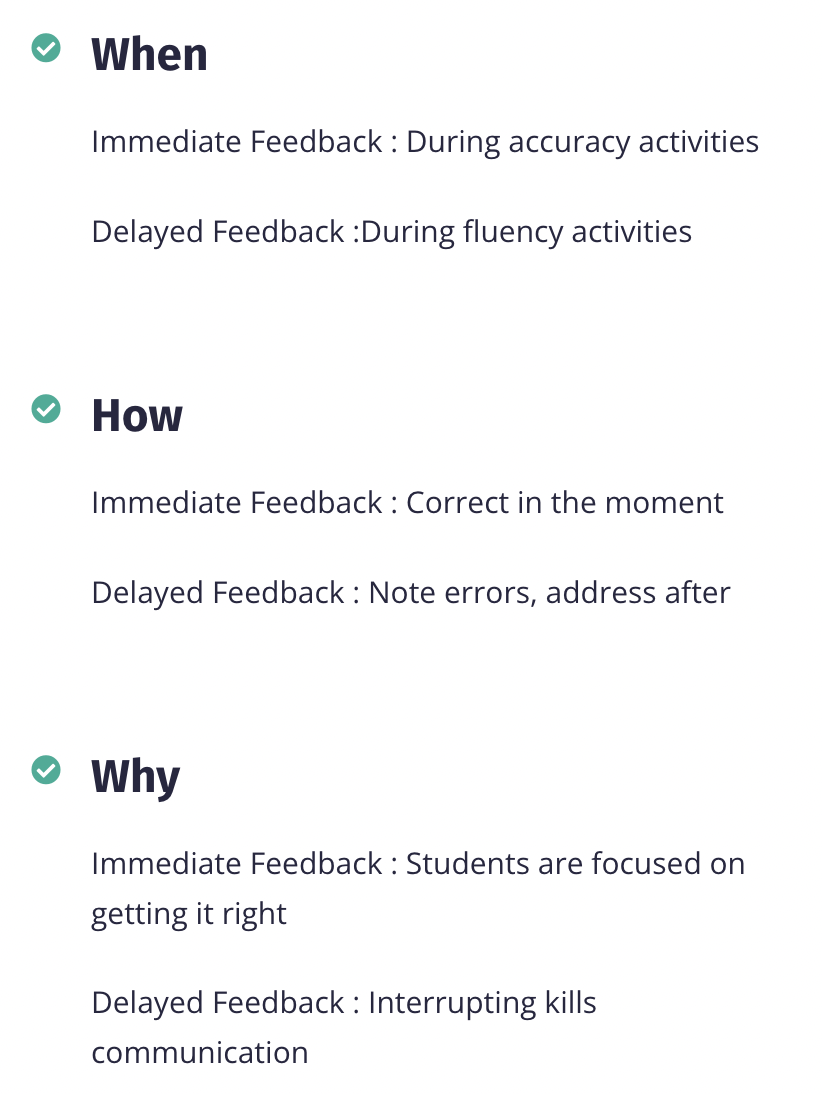
Two types of spoken feedback
Immediate feedback — Given during or right after a student speaks. Best used during accuracy-focused activities.
Delayed feedback — Collected during the activity and addressed at the end. Best used during fluency-focused activities.
During Accuracy Activities → Use Immediate Feedback
When students are practising a specific grammar structure or doing controlled exercises, correct errors as they happen — gently and clearly.
Here are four techniques you can use:
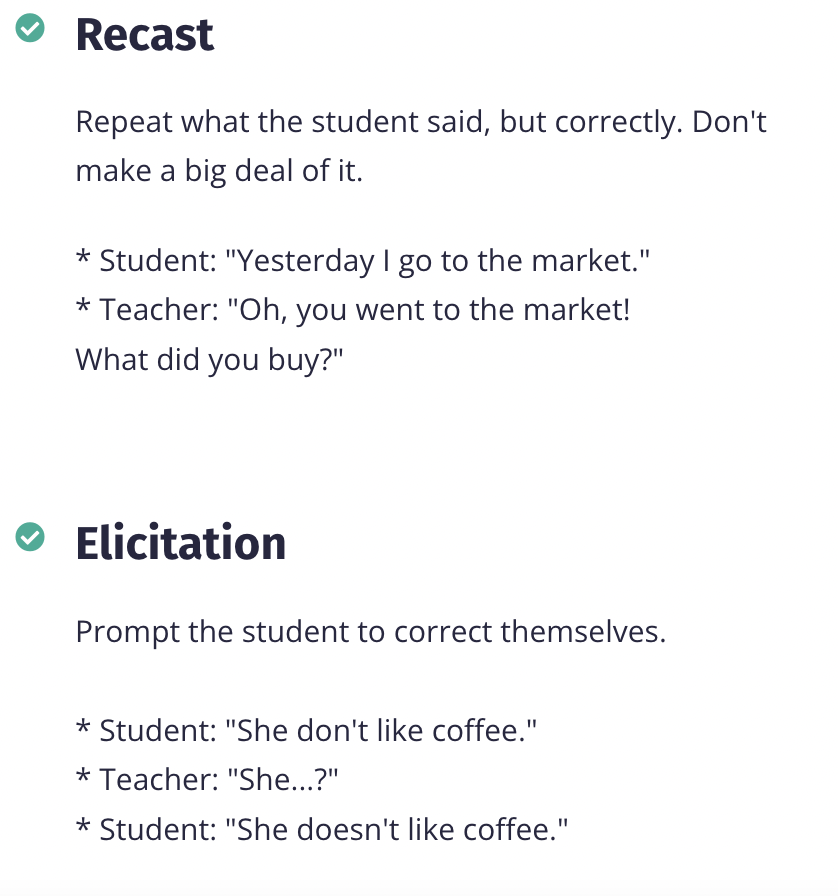
Recast — Repeat what the student said, but correctly. - Student: "Yesterday I go to the market." - Teacher: "Oh, you went to the market! What did you buy?"
Elicitation — Prompt the student to correct themselves. - Student: "She don't like coffee." - Teacher: "She...?" - Student: "She doesn't like coffee."
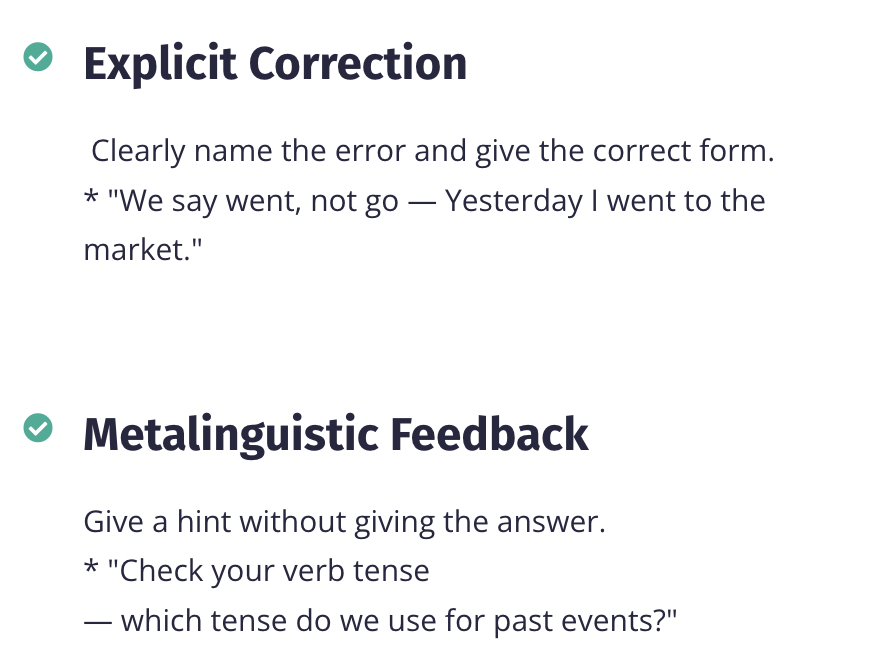
Explicit Correction — Clearly name the error and give the correct form. - "We say went, not go — Yesterday I went to the market."
Metalinguistic Feedback — Give a hint without giving the answer. - "Check your verb tense — which tense do we use for past events?"
During Fluency Activities → Use Delayed Feedback
When students are doing discussions, role plays, or debates, do not interrupt. Let them speak freely. Instead: 1. Carry a notepad and quietly write down errors you hear 2. After the activity, write selected errors on the board — without naming who said them 3. Ask the class to correct the errors together
This approach: - Keeps communication flowing during the activity - Avoids embarrassing individual students - Turns mistakes into a learning moment for the whole class
Don't Forget Positive Feedback
Correction is only half the job. Students also need to hear what they are doing well. - "That was a really natural way to express your opinion — well done." - "I noticed you used a great phrase there — keep doing that."
Positive feedback builds confidence and encourages students to keep taking risks with the language.
✓Common mistakes to avoid:
- Correcting every single error → overwhelms students and kills fluency
- Only giving negative feedback → students lose motivation
- Being vague → "Good job" means nothing. Be specific.
- Interrupting during fluency tasks → breaks communication and discourages participation
Key takeaway: The best feedback is timely, specific, and encouraging.
✓By the end of this lesson, you should be able to:
- Explain the difference between immediate and delayed feedback
- Apply four spoken correction techniques in your teaching
- Describe how to use delayed feedback effectively during fluency activities