Why Pronunciation Matters — Intelligibility Over Perfection
The goal of pronunciation teaching is not a perfect accent — it is clear, confident communication that others can understand.
Before you can teach pronunciation effectively, you need to understand what the goal actually is — and why it is not a perfect native-speaker accent.
Why pronunciation is often neglected
Many teachers feel uncomfortable teaching pronunciation because: - They are unsure of the rules themselves - They don't want to embarrass students - They focus on grammar and vocabulary instead
The result is students who can write well but struggle to be understood in conversation.
The intelligibility principle
Intelligibility means being understood by the listener — not sounding like a native speaker.
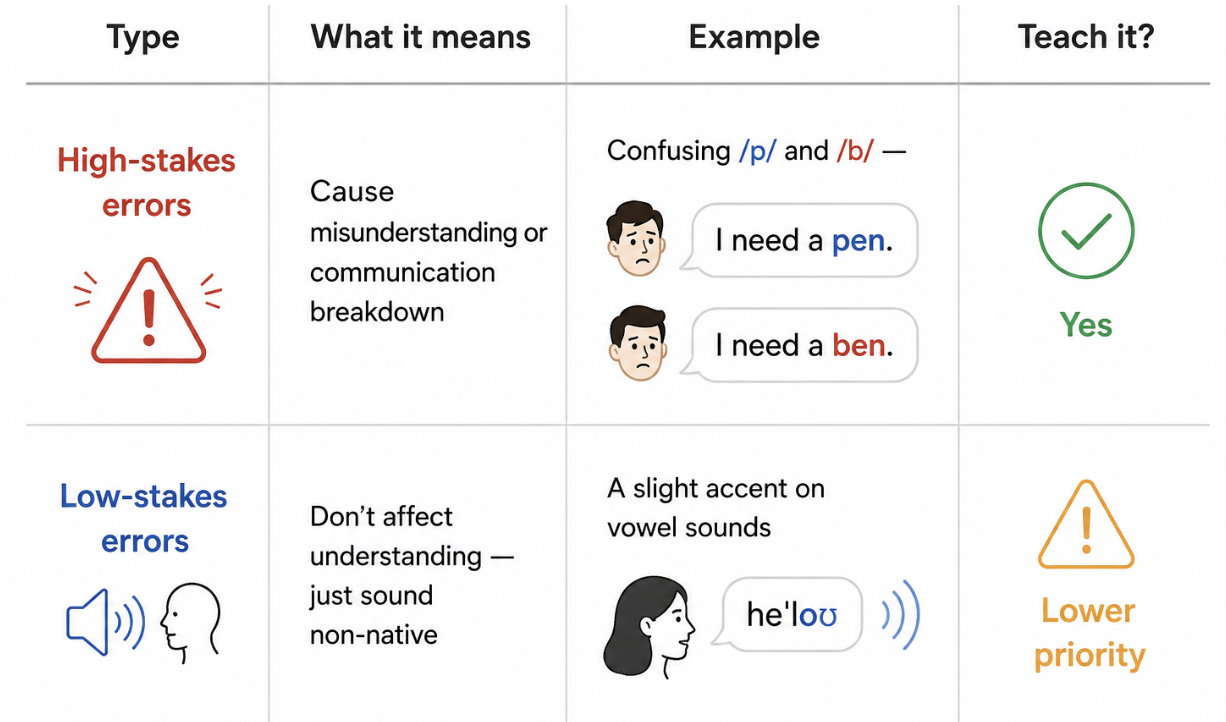
Research shows that: - A strong accent does not prevent communication if pronunciation is clear - Many pronunciation errors do not actually cause misunderstanding - Some errors, however, do affect intelligibility significantly — and those are the ones worth teaching
Your focus as a teacher: Identify and address the pronunciation errors that actually affect communication — not every imperfection.
Two types of pronunciation errors
✓Why accent should not be the goal
- English is a global language — there is no single correct accent
- Non-native English speakers now outnumber native speakers
- Students interact with other non-native speakers as much as native speakers
- A learner accent is not a deficiency — it is part of a speaker's identity
Key principle: Aim for intelligibility, not imitation. Teach students to communicate clearly — not to sound like someone they are not.
✓What this means for your teaching
- Focus on high-stakes pronunciation errors first
- Prioritize sounds, stress, and rhythm that affect meaning
- Be sensitive — pronunciation is closely tied to identity and confidence
- Create a low-pressure environment where students feel safe to practice
- Model pronunciation clearly without demanding perfect imitation
✓By the end of this lesson, you should be able to:
- Explain why intelligibility — not accent — is the goal of pronunciation teaching
- Distinguish between high-stakes and low-stakes pronunciation errors
- Describe what this means for how you approach pronunciation in the classroom