Fluency vs. Accuracy — Finding the Balance
One of the most important decisions a speaking teacher makes is when to focus on fluency and when to focus on accuracy.
What is fluency? Fluency refers to the ability to speak smoothly, naturally, and with confidence — without long pauses or constant self-correction.
What is accuracy? Accuracy refers to using correct grammar, vocabulary, and pronunciation.
Why both matter
Neither fluency nor accuracy alone is enough. A speaker who is highly accurate but very slow may struggle to hold a real conversation. A speaker who is fluent but makes frequent errors may develop fossilized mistakes — errors that become habits and are very difficult to correct later.
Fluency activities
Fluency activities prioritize communication over correctness. Examples: - Discussion tasks and debates - Role plays and simulations - Storytelling and narrative tasks - Information gap activities
During fluency activities: Do not interrupt students to correct errors. Note mistakes and address them after the activity.
Accuracy activities
Accuracy activities focus on producing language correctly. Examples: - Controlled drilling of a target structure - Guided dialogue practice - Sentence-level repetition and substitution drills
During accuracy activities: Provide immediate, supportive correction when errors occur.
The PPP model in speaking lessons
Many speaking lessons follow the Presentation-Practice-Production (PPP) structure:
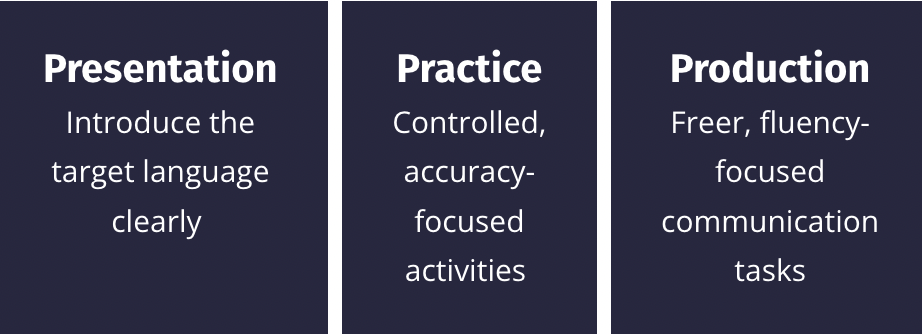
This progression moves students from accuracy toward fluency in a structured way.
Key takeaway: Speaking is a complex, multi-layered skill that develops through practice, exposure, and encouragement. The more opportunities students have to speak meaningfully in English, the more confident and fluent they become.