What is a Syllabus? Types and Purposes
A great teacher can deliver a lesson. A great educator can design an entire course. Syllabus and curriculum design is the skill that takes you from the classroom to the big picture.
Before you can design a syllabus, you need to understand what one actually is — and why the decisions you make at the design stage shape everything that happens in the classroom. What is a syllabus? A syllabus is a document that outlines what will be taught in a course — the content, sequence, and learning goals. It is the blueprint of a course. A syllabus answers three fundamental questions:
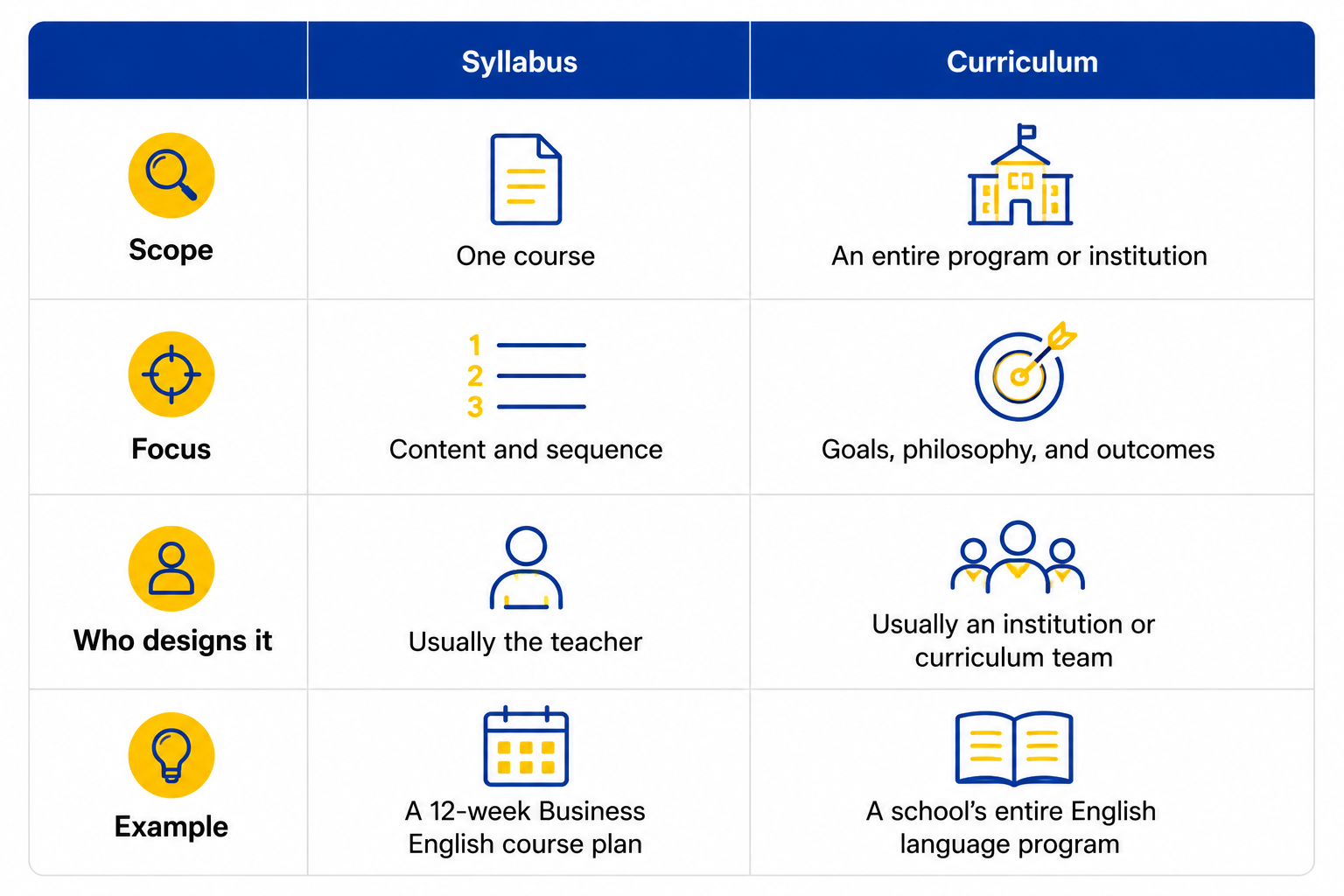
A syllabus is not the same as a lesson plan. A lesson plan describes what happens in a single class. A syllabus describes what happens across an entire course. Syllabus vs Curriculum These terms are often used interchangeably — but they are not the same.
In most teaching contexts, you will be responsible for designing syllabuses — not entire curricula. But understanding both helps you see how your course fits into the bigger picture. Types of syllabus There is no single correct way to organize a syllabus. Different types prioritize different organizing principles.
✓Structural syllabus (Grammar-based)
Organized around grammatical structures, sequenced from simple to complex.
- Example: Present simple → Past simple → Present perfect → Future forms
- Best for: Beginners who need a systematic grammar foundation
- Limitation: Language is taught out of context; may not reflect real communication needs
✓Functional syllabus
Organized around communicative functions — what students need to do with language.
- Example: Greeting people → Making requests → Giving opinions → Apologizing
- Best for: Students with specific communication goals
- Limitation: Grammar may be taught inconsistently
✓Situational syllabus
Organized around real-world situations students will encounter.
- Example: At the airport → In a hotel → In a meeting → On the phone
- Best for: Tourism, hospitality, and vocationally-oriented courses
- Limitation: May not develop systematic language knowledge
✓Topic-based syllabus
Organized around themes or topics relevant to the learners.
- Example: Technology → Environment → Health → Culture → Work
- Best for: General English courses with adult learners
- Limitation: Language progression may be difficult to sequence logically
✓Task-based syllabus
Organized around meaningful tasks students must complete using language.
- Example: Plan a trip → Write a report → Conduct an interview → Give a presentation
- Best for: Learners who need English for specific real-world outcomes
- Limitation: Requires careful design to ensure language development
✓Competency-based syllabus
Organized around specific competencies or skills students must demonstrate.
Most syllabuses are hybrid
In real-world teaching, most effective syllabuses combine elements of two or more types. For example:
The key is not to pick one type and stick to it rigidly — it is to make thoughtful decisions based on your learners' needs.
- Example: Can understand main points of clear standard speech → Can write simple connected text
- Best for: Vocational and workplace English programs
- Limitation: May feel mechanical if not balanced with communicative activities
- A Business English course might combine a functional syllabus (what students need to do) with a situational syllabus (the contexts they work in)
- A General English course might combine a structural syllabus (grammar progression) with a topic-based syllabus (engaging themes)
Factors to consider when choosing: - Who are the learners? What are their goals? - How long is the course? - What resources and materials are available? - What does the institution require? - What assessment will students complete? The syllabus serves the learners — not the other way around. Start with who your students are and what they need, then choose the organizing principle that best serves those needs.
✓Key takeaway :
- Explain what a syllabus is and how it differs from a curriculum
- Describe six types of syllabus and their advantages and limitations
- Identify which syllabus type is most appropriate for different teaching contexts