Teaching Young Learners and Teenagers
Knowing how to teach English is one thing. Knowing how to teach it in a real classroom — with real students, real constraints, and real challenges — is another.
Teaching Young Learners (ages 5–12)
How young learners learn
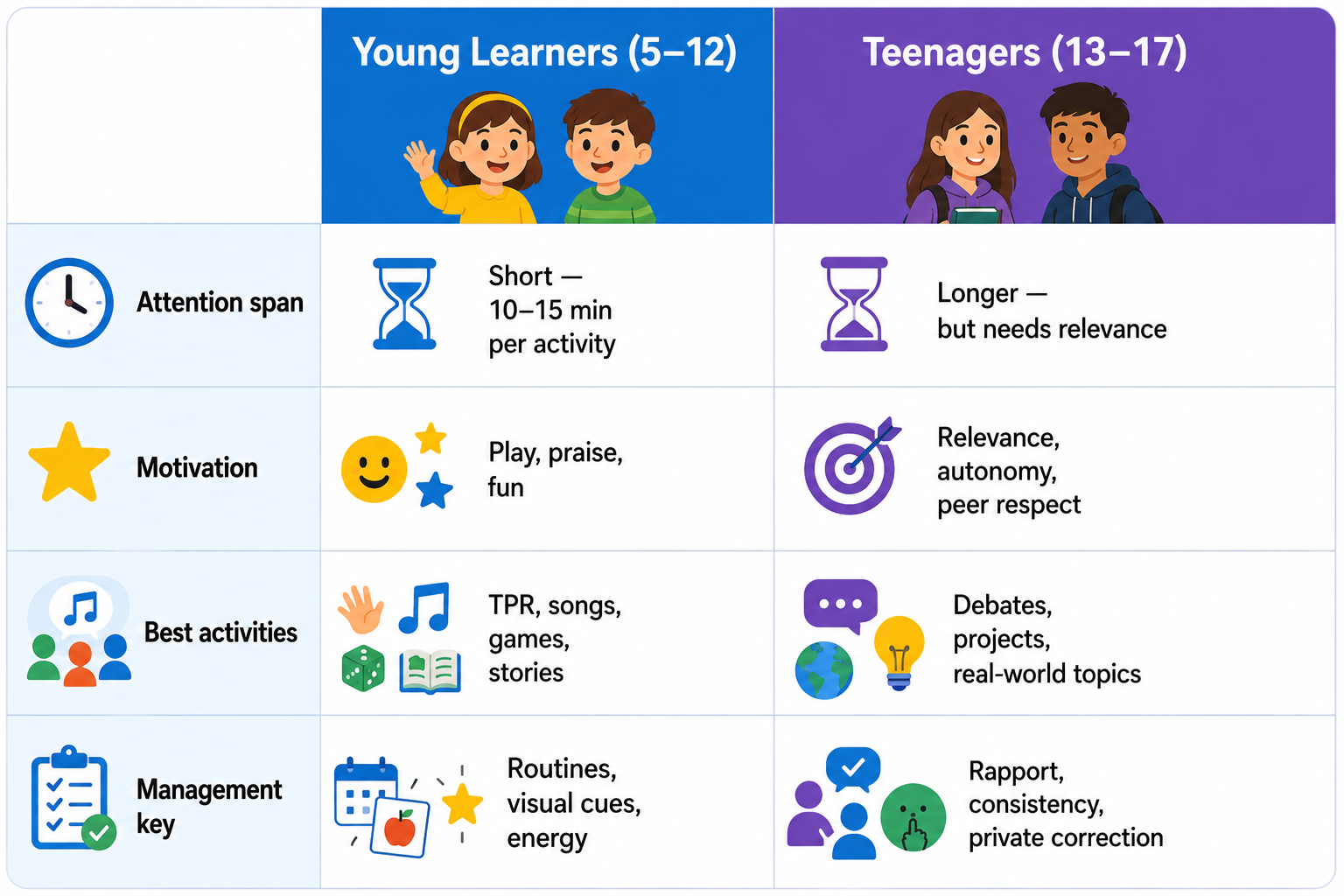
Young learners acquire language differently from adults. Key characteristics: - They learn through play, movement, and sensory experience - They have shorter attention spans — typically 10–15 minutes per activity - They respond to repetition — songs, chants, and routines help language stick - They are less self-conscious about making mistakes - They cannot sit still for long periods — they need physical engagement - They respond to visual and hands-on materials
✓What works in the young learner classroom
- Total Physical Response (TPR) — students respond to instructions with physical actions: "Stand up. Touch your nose. Jump three times."
- Songs and chants — rhythm and melody make language memorable. "Head, shoulders, knees and toes" teaches body vocabulary through movement.
- Storytelling — young learners love stories. Use picture books, puppets, and mime to bring language to life.
- Games — learning disguised as play. Bingo, matching, Simon Says, and memory games all build language while keeping energy high.
- Short, varied activities — change activity every 10–15 minutes to maintain focus.
✓Classroom management with young learners
- Use clear, simple instructions with demonstrations — not long explanations
- Establish strong routines — young learners feel safe with predictability
- Use visual cues and signals — a raised hand, a bell, or a countdown for transitions
- Keep energy positive — praise effort enthusiastically and consistently
- Have a clear behavior system — simple, visual, and consistent
Teaching Teenagers (ages 13–17)
Teenagers are often considered the most challenging group to teach — but they can also be the most rewarding.
✓How teenagers learn
- They are developing their identity and care deeply about how they are perceived by peers
- They respond to relevance — "Why do I need to learn this?" is always present, even if unspoken
- They have longer attention spans than young learners but are easily disengaged by irrelevant content
- They respond to autonomy — being given choices and treated with respect
- They are highly social — peer interaction is central to their motivation
- They can be self-conscious about making mistakes in front of peers
✓What works in the teenage classroom
- Connect to their world — use topics relevant to their lives: music, social media, sport, film, identity, future plans
- Give them choice — let students choose topics, partners, or task formats where possible. Autonomy increases motivation.
- Use collaborative tasks — teenagers are motivated by social interaction. Group projects, debates, and team challenges work well.
- Treat them as adults — respect their opinions, take their ideas seriously, and avoid talking down to them
- Use humor carefully — light, inclusive humor builds rapport. Never use sarcasm or humor that singles out individuals.
✓Classroom management with teenagers
- Set clear expectations from day one — be consistent and fair
- Build rapport before authority — teenagers respond to teachers they respect, not just teachers they fear
- Address problems privately — public correction embarrasses teenagers and damages trust
- Channel energy positively — give restless students leadership roles in activities
✓Key takeaway — you should be able to:
- Describe how young learners and teenagers learn differently from adults
- Select appropriate activities and approaches for each age group
- Apply effective classroom management strategies for young learners and teenagers