Pronunciation Activities and Correction Techniques
Pronunciation improves through hearing, noticing, and practicing. This lesson gives you a practical toolkit of activities and correction techniques to use in your classroom.
Part 1: Pronunciation Activities
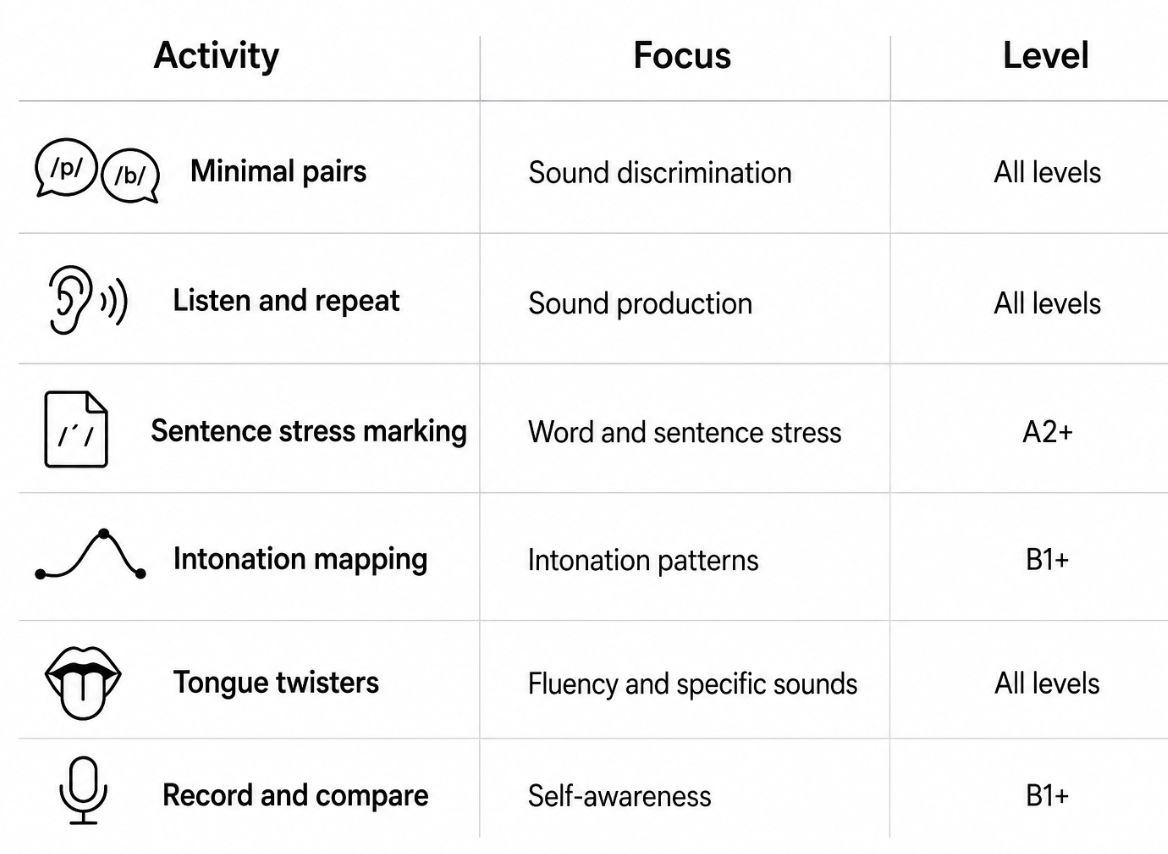
Minimal pair drills — Students listen to and produce pairs of words that differ by one sound. - Students listen and identify which word they hear (A or B) - Then students produce both words in sentences - Best for: Sound discrimination and production - Level: All levels
Listen and repeat — The teacher (or a recording) models a word, phrase, or sentence. Students listen and repeat. - Focus on one feature at a time — sounds, stress, or intonation - Drill as a class, then in pairs, then individually - Best for: Building muscle memory for new sounds - Level: All levels
Sentence stress marking — Give students a sentence and ask them to identify which words are stressed. - "The TRAIN leaves at NINE o'clock." - Students mark stress with underlining or capital letters - Best for: Teaching rhythm and sentence stress - Level: A2 and above
Intonation mapping — Students listen to a sentence and draw the intonation pattern as a line. - Teacher says: "Are you coming?" → students draw an upward line - Compare with: "I'm not coming." → students draw a downward line - Best for: Making intonation visible and teachable - Level: B1 and above
Tongue twisters — Fast, repetitive sentences designed to practice a specific sound. - "She sells seashells by the seashore." → /s/ and /ʃ/ - "Red lorry, yellow lorry." → /r/ and /l/ - "Peter Piper picked a peck of pickled peppers." → /p/ - Best for: Fluency, sound accuracy, and fun! - Level: All levels
Record and compare — Students record themselves speaking, then listen back and compare with a model. - Best for: Developing self-awareness and autonomy - Level: B1 and above
Part 2: Correction Techniques
Modeling (Recast) — The teacher repeats the student's utterance with correct pronunciation — naturally, without drawing attention to the error. - Student: "I need a /fɔːk/ [fork mispronounced]." - Teacher: "Oh, you need a fork! Here it is." - Natural and non-threatening - Best used during fluency activities
Explicit correction — The teacher directly identifies the error and provides the correct form. - "Be careful with that sound — it's /θɪŋk/ not /tɪŋk/. Listen: think. Now you try." - Clear and direct - Best used during accuracy-focused activities
Finger technique — The teacher uses fingers to represent the syllables of a word — pointing to the stressed syllable. - "Com-for-ta-ble" → hold up four fingers, point to the first: COM-for-ta-ble - Visual and kinesthetic — very effective for word stress - Best for: Beginners and lower intermediate
Backchaining — The teacher builds up a long word or phrase from the end. - Target: "I should have told him." - Step 1: "him" - Step 2: "told him" - Step 3: "have told him" - Step 4: "should have told him" - Step 5: "I should have told him" - Helps students manage long, difficult words or phrases - Best for: Connected speech and complex pronunciation