Teaching Different Text Types and Genres
Different writing tasks have different purposes, structures, and language features. Students need to learn the conventions of each text type.
Why text types matter
Students who only practice one type of writing — usually essays — are unprepared for the range of writing they will encounter in real life. A well-rounded writing course exposes students to a variety of text types, each with its own conventions.
Core text types in ESL writing
Narrative writing — Telling a story or describing a sequence of events - Structure: Introduction → Events in order → Resolution/Conclusion - Language features: Past tenses, time connectors (first, then, after that, finally), descriptive language - Examples: Personal stories, short stories, diary entries - Task example: "Write about a memorable experience from your life."
Descriptive writing — Creating a vivid picture of a person, place, or thing - Structure: Introduction → Physical description → Atmosphere/impression - Language features: Adjectives, sensory language, present tense - Examples: Describing a place, a person, a photograph - Task example: "Describe your hometown to someone who has never visited."
Discursive / Argumentative writing — Presenting and supporting an argument or discussing both sides of an issue - Structure: Introduction (thesis) → Arguments with evidence → Counterargument → Conclusion - Language features: Formal register, hedging language, connectors (however, furthermore, on the other hand) - Examples: Essays, opinion pieces, reports - Task example: "Do you think social media has had a positive or negative effect on society?"
Instructional / Procedural writing — Explaining how to do something in a clear, logical sequence - Structure: Introduction → Numbered steps → Conclusion/Result - Language features: Imperative verbs (add, mix, click), sequence connectors (first, next, finally) - Examples: Instructions, recipes, how-to guides - Task example: "Write instructions for making your favorite dish."
Transactional writing — Writing with a specific communicative purpose for a specific audience - Structure: Varies by text type (email, letter, report) - Language features: Appropriate register (formal or informal), clear purpose - Examples: Formal emails, complaint letters, job applications - Task example: "Write a formal email to your teacher requesting an extension on your assignment."
Text types at a glance
How to teach a text type
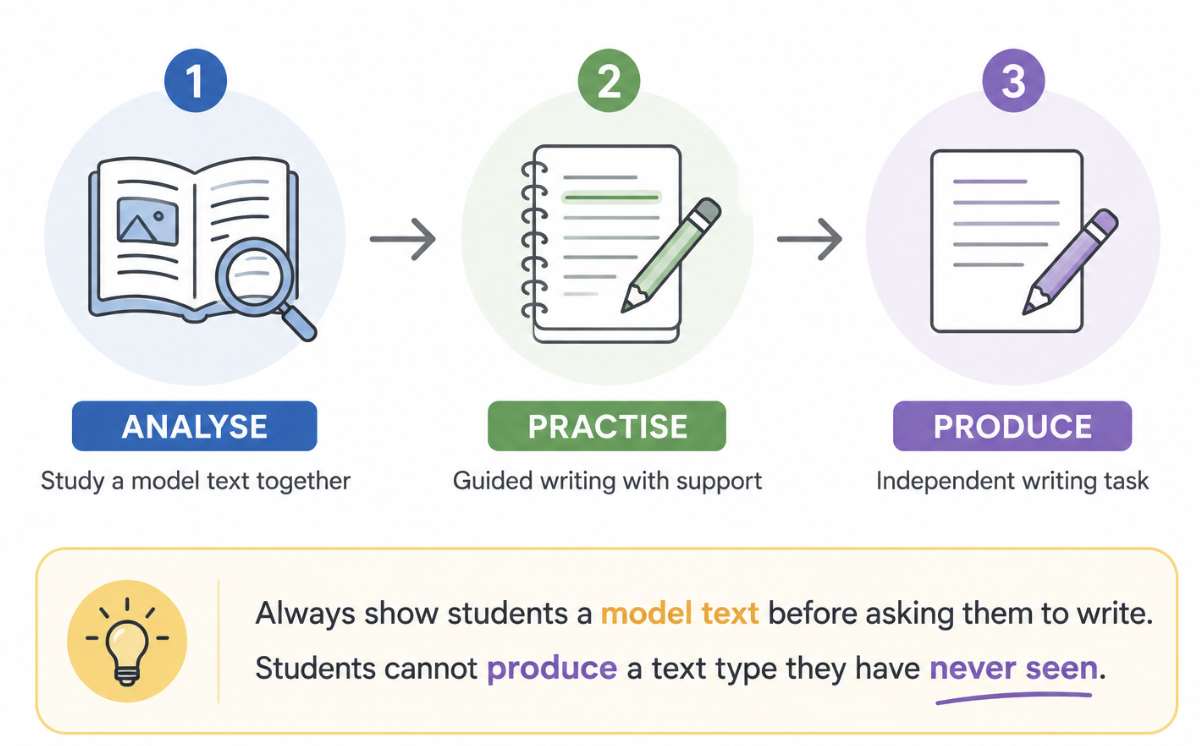
Step 1 → ANALYZE — Study a model text together Step 2 → PRACTICE — Guided writing with support Step 3 → PRODUCE — Independent writing task
Always show students a model text before asking them to write. Students cannot produce a text type they have never seen.
✓By the end of this lesson, you should be able to:
- Identify the five core text types in ESL writing
- Describe the structure and language features of each text type
- Explain how to use model texts to teach a new genre