Designing Simple and Effective Assessments
Knowing the principles of assessment is one thing. Designing assessments that actually work in your classroom is another. This lesson gives you practical tools to assess student progress simply and effectively — without spending hours preparing tests.
Start with the learning objective
Every assessment should connect directly to the learning objective of the lesson or unit. Ask yourself: "What did I say students would be able to do by the end of this lesson — and how will I know if they can do it?"
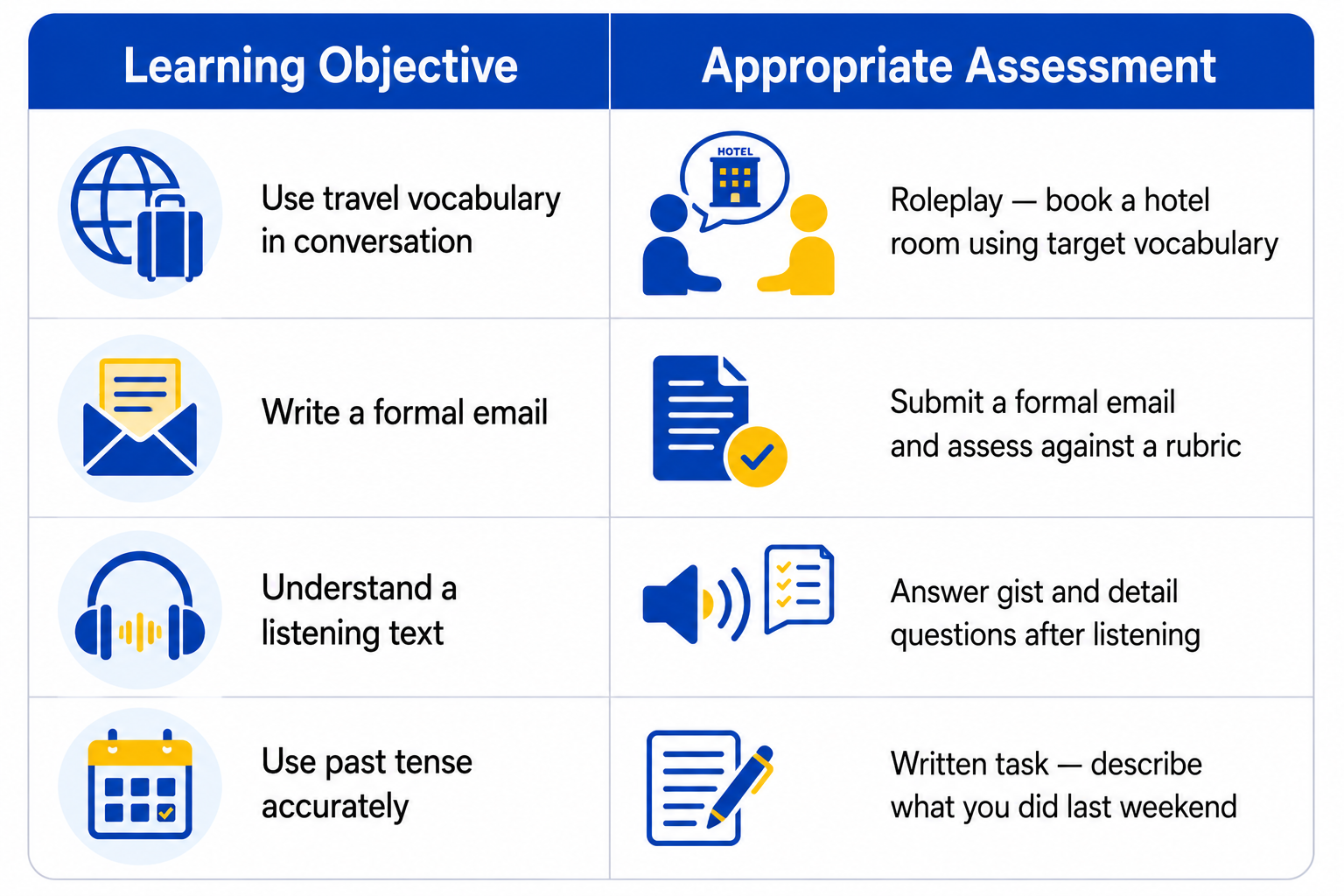
Types of classroom assessment tasks
Observation
The teacher watches and listens during activities — noting what students can and cannot do. - No preparation required - Gives real-time information - Use a simple checklist or notepad to record observations - Best for: Speaking, pronunciation, participation
Questioning
Strategic questions during lessons reveal understanding quickly and naturally. - Use a mix of question types — recall, comprehension, application, opinion - Use wait time — at least 5 seconds before accepting an answer - Distribute questions across the class — don't only ask confident students
Exit Tickets
At the end of a lesson, students write a brief response on a slip of paper before leaving.
Examples: - "Write one sentence using the grammar structure from today's lesson." - "What is one thing you understood today and one thing you are still unsure about?" - "Give an example of a collocation you learned today."
Benefits: - Takes 3–5 minutes - Gives the teacher immediate feedback on the lesson - Helps plan the next lesson based on actual student understanding
Rubrics
A rubric is a scoring guide that describes different levels of performance against clear criteria.
Example rubric for a speaking task:
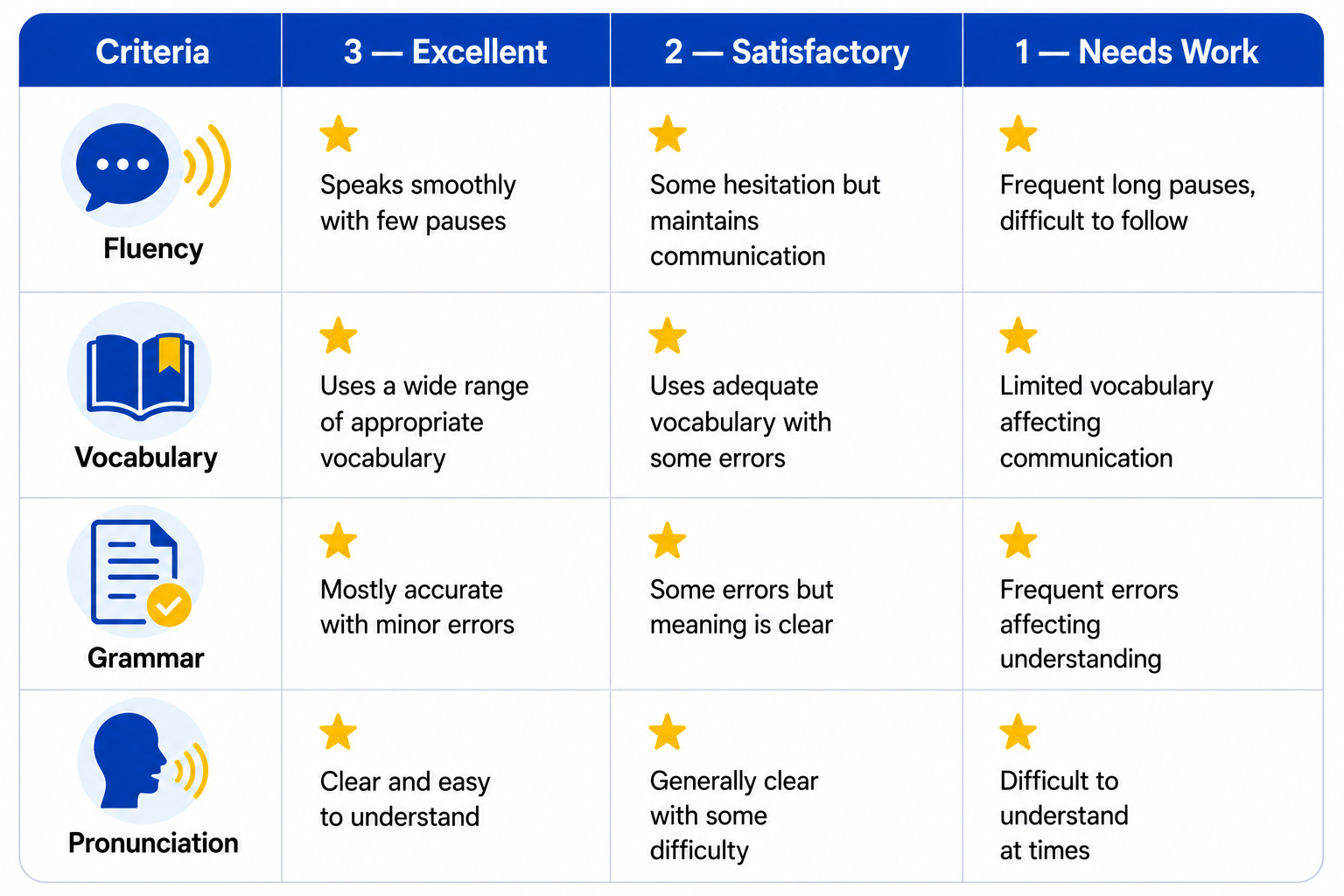
Benefits of rubrics: - Makes expectations transparent for students - Increases consistency and reliability of marking - Can be shared with students before a task — so they know what success looks like
Portfolios
Students collect samples of their work over time — writing tasks, recordings, reflections — into a portfolio that demonstrates progress. - Shows growth over time, not just a snapshot - Encourages student reflection and ownership of learning - More authentic than a single test - Best for: Writing, longer courses, professional development contexts
✓Key takeaway:
- Connect assessment tasks directly to learning objectives
- Use at least three types of classroom assessment in your teaching
- Design a simple rubric for a speaking or writing task